Tree Trimming vs. Tree Removal in Sanford, Maine: Which Does Your Tree Need?
A damaged, overgrown, or unhealthy tree does not always need to be removed. In many cases, professional trimming can eliminate hazardous branches, improve the tree’s structure, and preserve it for years. However, when the trunk, roots, or overall stability has been seriously compromised, complete removal may be the safest option.
Understanding the difference between tree trimming vs. tree removal in Sanford, Maine can help you protect your home, avoid unnecessary work, and make the right long-term decision for your property.
Black Bear Tree Co. provides professional tree service in Sanford, Maine, including tree trimming, hazardous tree removal, storm cleanup, and stump grinding.
If you are unsure what your tree needs, request a free on-site assessment or call Black Bear Tree Co. at 207-387-5064.
Tree Trimming vs. Tree Removal: What Is the Difference?
The main difference is simple:
- Tree trimming removes selected branches while preserving the tree.
- Tree removal takes down the entire tree when keeping it would create an unacceptable risk or no longer serve the property.
Professional tree trimming in Sanford is intended to address specific branches, improve clearance, remove deadwood, and support better structure.
Professional tree removal in Sanford eliminates the entire tree when its condition, location, or stability makes preservation impractical or unsafe.
Choosing between these services requires looking beyond appearance. The tree’s health, structure, root system, location, surrounding targets, and history of damage all matter.
A tree that appears unhealthy may only need dead or damaged limbs removed. Meanwhile, a tree that still produces green leaves can have internal decay or structural problems that make removal necessary.
An evaluation from a licensed arborist serving Sanford can help determine whether the tree can be safely preserved.
When Tree Trimming Is Usually the Better Choice
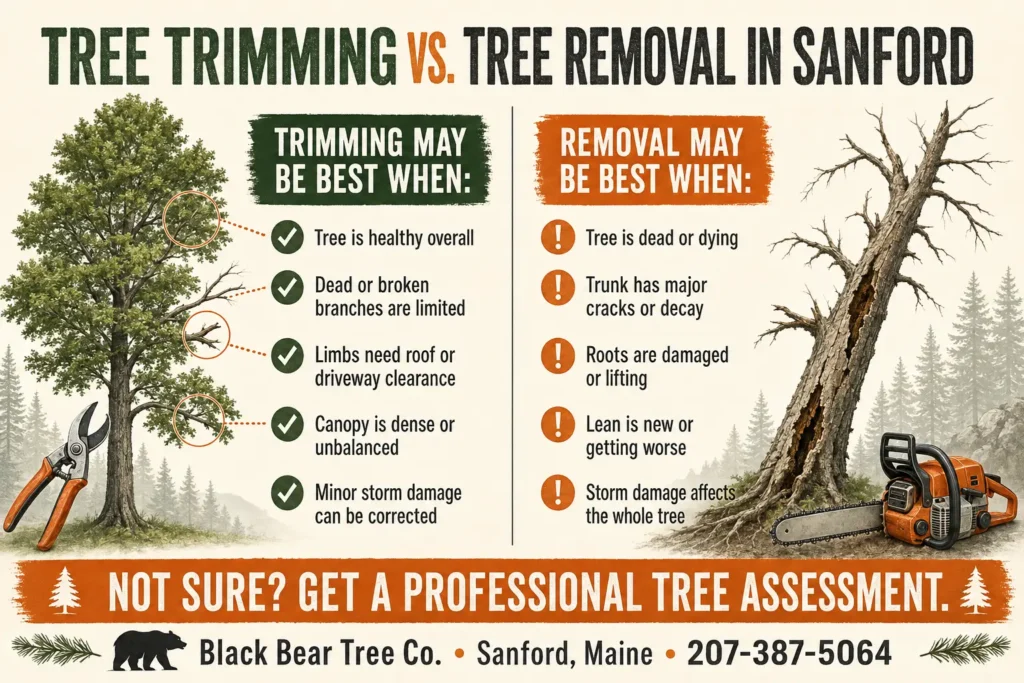
Professional tree trimming services are generally the better option when the tree is structurally stable and its problems are limited to particular branches.
The Tree Is Healthy Overall
A healthy trunk, stable root system, and strong central structure are all good signs. If the tree’s primary issue is overgrowth, minor storm damage, or several dead branches, trimming may be all that is necessary.
Strategic pruning can preserve a valuable mature tree while addressing the branches creating risk. Black Bear Tree Co.’s Sanford arborist services can help identify which limbs should be removed and which should remain.
The International Society of Arboriculture explains that properly planned pruning can improve tree structure, remove damaged branches, and reduce certain safety concerns.
There Are Dead or Broken Branches
Dead branches can fall without warning, especially during Sanford’s wind, snow, and ice events. Removing them can reduce the risk of property damage without sacrificing the entire tree.
If damage occurred during severe weather, a Sanford storm-cleanup evaluation can identify broken limbs, suspended branches, split leaders, and trees that may have shifted at the roots.
For damage that creates an immediate threat, Black Bear also provides 24-hour emergency tree service throughout Southern Maine.
Branches Are Growing Toward Your Home
Branches scraping a roof, hanging over a driveway, or growing toward siding may be corrected through targeted trimming.
Professional tree pruning in Sanford can create appropriate clearance while maintaining a balanced canopy. Removing too much growth at once or making poor cuts can weaken the tree, so the work should be planned carefully.
Trees growing extremely close to a home may require a broader tree-risk assessment to determine whether trimming will provide a lasting solution.
The Canopy Is Too Dense or Unbalanced
A crowded or uneven canopy can place additional stress on individual limbs. Selective pruning may remove crossing, damaged, dead, or poorly attached branches while preserving the tree’s natural shape.
The goal is not to strip the canopy. It is to make careful cuts that address specific problems while retaining enough healthy foliage for the tree.
If you are comparing prices, Black Bear’s 2026 tree-trimming cost guide explains the factors that affect professional pruning estimates.
You Need Better Sunlight or Clearance
Tree trimming may also be appropriate when branches are:
- Blocking sunlight from reaching the yard
- Hanging too low over a driveway
- Restricting access around a building
- Interfering with visibility
- Crowding other healthy trees
- Resting against a roof or structure
- Blocking equipment access
- Encroaching on a planned outdoor space
If the tree remains healthy and appropriately located, trimming is usually less disruptive than removing it.
Properties with more extensive overgrowth may benefit from brush clearing in Sanford or professional lot clearing in Sanford in addition to individual tree maintenance.
When Tree Removal May Be the Safer Choice
Professional tree removal in Sanford, Maine may be necessary when the entire tree presents a problem that trimming cannot correct.
The Tree Is Dead or Dying
A dead tree cannot recover. As its wood deteriorates, branches become more likely to break, and the trunk can gradually lose structural strength.
Warning signs may include:
- No leaves during the normal growing season
- Large areas of missing bark
- Brittle branches throughout the canopy
- Extensive decay
- Fungal growth around the trunk or roots
- Increasing branch failure
- Severe insect or disease damage
- Little or no healthy growth over multiple seasons
Not every bare branch means the whole tree is dead. A professional tree-health evaluation in Sanford can distinguish localized dieback from tree-wide decline.
When removal is necessary, Black Bear Tree Co. provides controlled tree removal followed by optional stump grinding in Sanford.
The Trunk Has Major Cracks or Decay
Large cavities, vertical cracks, hollow sections, and extensive decay can weaken the tree’s primary structure. Trimming the canopy may reduce some weight, but it cannot restore a severely compromised trunk.
The International Society of Arboriculture’s tree-risk information identifies cracks, decay, dead branches, weak attachments, and root problems as conditions that may warrant professional evaluation.
If the tree is large or located near a structure, crane-assisted tree removal in Sanford may allow sections to be lifted and controlled more precisely.
The Tree Is Leaning and the Lean Is Getting Worse
Some trees naturally grow at an angle and remain stable for decades. A newly developing or increasing lean is more concerning, particularly when accompanied by:
- Lifted or cracked soil
- Exposed roots
- Root-plate movement
- Cracks near the base
- Recent storm damage
- A lean toward a home, road, or driveway
These conditions can indicate a loss of root support. If the tree threatens an occupied area or valuable structure, hazardous tree removal in Sanford may be the safest solution.
If the lean appeared suddenly following strong winds or saturated soil, contact emergency tree service and keep people, vehicles, and pets away from the potential fall zone.
The Root System Has Been Severely Damaged
Construction, excavation, soil compaction, drainage changes, and repeated vehicle traffic can damage roots. Because roots anchor and support the entire tree, major root loss may affect stability even when the canopy still appears green.
Trees near recent construction should be inspected when roots were cut, soil was added or removed, or heavy equipment repeatedly crossed the root zone.
A Sanford arborist evaluation can help determine whether the damage is limited or whether the tree has lost essential structural support.
The Tree Is in the Wrong Location
A healthy tree may still need to be removed if it has outgrown the available space or is creating a conflict that responsible trimming cannot correct.
Examples include a tree:
- Growing too close to a foundation
- Repeatedly damaging a roof
- Crowding a building or septic area
- Blocking a planned addition
- Preventing driveway or equipment access
- Creating an ongoing safety hazard
- Growing beneath utility infrastructure
- Interfering with a planned construction project
Continually cutting back a poorly located tree can cost more over time while producing an unhealthy or unbalanced structure.
If multiple trees must be removed for a building site, driveway, or property improvement, review Black Bear’s Sanford lot-clearing services and the 2026 lot-clearing cost guide.
The Tree Has Suffered Severe Storm Damage
A tree that loses one or two branches may recover with corrective pruning. A tree with a split trunk, uprooted root system, destroyed crown, or multiple failed leaders may not be safely salvageable.
Black Bear Tree Co. provides storm cleanup in Sanford, Maine for fallen trees, hanging limbs, damaged trees, and storm debris.
For urgent situations, read about emergency tree-removal costs in Southern Maine or call 207-387-5064.
Do not walk beneath hanging branches or attempt to cut bent limbs and trunks under tension.
Quick Comparison: Trimming or Removal?
| Tree condition | Trimming may help | Removal may be needed |
|---|---|---|
| Several dead branches | Yes | Sometimes |
| Healthy but overgrown canopy | Yes | Usually not |
| Branches over a roof | Yes | If the whole tree is unsafe |
| Minor storm damage | Yes | Sometimes |
| Dead tree | No | Yes |
| Major trunk decay | Limited benefit | Often |
| Severely damaged roots | Limited benefit | Often |
| Recent worsening lean | Unlikely | Often |
| Split trunk | Rarely | Often |
| Healthy tree in a poor location | Temporarily | Possibly |
This table offers general guidance, but it cannot replace an on-site inspection. The correct recommendation depends on the tree, its surroundings, and what could be struck if part or all of the tree failed.
Can Trimming Save a Damaged Tree?
Sometimes. Corrective trimming may save a tree when the damage is limited and the remaining trunk and root system are stable.
A professional may recommend trimming to:
- Remove broken or hanging limbs
- Reduce weight on a damaged branch
- Correct an unbalanced canopy
- Remove diseased or dead wood
- Improve clearance from a structure
- Reduce a specific structural concern
However, trimming cannot reverse extensive trunk decay, restore severed roots, or make a dead tree healthy again.
It is also important to avoid tree topping. Topping indiscriminately removes major portions of the canopy, leaving large wounds and potentially weak new growth. The ISA explains why topping harms trees and why appropriate pruning should have a defined purpose.
Black Bear’s professional trimming service in Sanford focuses on removing problem branches without unnecessarily damaging the remaining tree.
Does Tree Trimming Prevent Future Removal?
Proper trimming can sometimes extend a tree’s useful life and reduce the likelihood of branch failure. Removing weak, crossing, broken, or poorly attached branches early may prevent manageable defects from becoming larger problems.
However, trimming cannot guarantee that a tree will never need removal. Trees are affected by age, storms, disease, insects, soil conditions, construction, and environmental changes.
Routine inspections and responsible maintenance offer the best opportunity to identify problems before they become emergencies. The Black Bear tree-care blog provides additional information about tree removal, pruning, storm damage, stump grinding, and property clearing.
What About Trees Near Power Lines?
Do not attempt to trim or remove a tree that is contacting or extremely close to an energized electrical line.
Central Maine Power’s electrical safety guidance advises people to treat downed wires as energized and stay away from trees or objects touching electrical equipment.
If a tree or branch has fallen onto a line:
- Stay well away from the area
- Keep children and pets back
- Assume every wire is energized
- Contact the electric utility
- Call emergency services when there is an immediate threat
- Never touch the tree or anything contacting it
Never use a ladder, pole saw, or chainsaw near overhead electrical equipment. Utility involvement may need to occur before a Sanford tree-removal crew can safely begin work.
Tree Trimming vs. Tree Removal Cost in Sanford
Tree trimming generally costs less than removing an entire tree, but the actual price depends on the work involved.
Factors affecting trimming cost include:
- Tree height
- Number and size of branches
- Canopy density
- Accessibility
- Proximity to structures
- Equipment requirements
- Cleanup and debris removal
Review the complete tree-trimming cost guide for Southern Maine for current planning ranges and pricing factors.
Factors affecting removal cost include:
- Tree height and trunk diameter
- Tree condition
- Lean and structural stability
- Proximity to a house, garage, or utility line
- Crane or specialized equipment requirements
- Access for trucks and equipment
- Wood and debris removal
- Whether stump grinding is included
Current pricing factors are explained in the 2026 tree-removal cost guide.
Large trees, backyard trees, and hazardous trees near structures may require crane tree removal, while the remaining stump can be handled through professional stump grinding.
For more information about stump pricing, read the stump-grinding cost guide and the comparison of stump grinding vs. stump removal.
The most reliable way to compare your options is with a free on-site estimate. In some cases, trimming is the clear answer. In others, repeatedly trimming a severely declining or poorly located tree can cost more than addressing the underlying problem.
Should You Remove a Tree as a Preventive Measure?
Not every large tree is dangerous, and size alone is not a reason for removal. Mature trees can provide shade, privacy, beauty, wildlife habitat, and property value.
Preventive removal may be reasonable when a qualified professional identifies an unacceptable risk that cannot be reduced through trimming or another practical treatment.
The decision should consider:
- The likelihood of failure
- The portion of the tree most likely to fail
- What the tree could strike
- The likely consequences
- Whether trimming could reduce the risk
- The tree’s expected long-term condition
- The cost of continued maintenance
- Whether the tree is appropriate for its location
A responsible Sanford tree company should explain why removal is recommended and whether preserving the tree is a realistic alternative.
Why Sanford Homeowners Should Address Tree Problems Early
Sanford properties experience heavy snow, ice accumulation, wind, saturated soil, and seasonal storms. These conditions can expose structural problems that were previously difficult to see.
Early evaluation provides more options. A weak branch may be removable before it lands on a roof. A young tree with poor structure may be corrected before the defect becomes severe. A declining tree may be removed under controlled conditions instead of during an emergency.
Preventive work also gives the crew more flexibility when planning equipment access and protecting surrounding landscaping.
You can see examples of completed projects in Black Bear’s Southern Maine tree-service gallery and learn more about the company through its Southern Maine tree-service homepage.
Tree Service Near Sanford and Throughout Southern Maine
Black Bear Tree Co. serves Sanford and communities across York and Cumberland counties. Homeowners outside Sanford can explore the appropriate local service page or use the main Southern Maine tree-services page.
Nearby service areas include:
- Tree service in Alfred
- Tree service in Shapleigh
- Tree service in Waterboro
- Tree services in Limerick
- Tree service in Newfield
- Tree service in Parsonsfield
- Tree service in Cornish
- Tree service in Limington
- Tree service in Hollis
- Tree service in Buxton
- Tree service in Dayton
- Tree service in Saco
- Tree service in Biddeford
- Tree service in Kennebunk
- Tree service in Gorham
- Tree service in Standish
- Tree service in Scarborough
- Tree service in Portland
- Tree service in Windham
If a town-specific service is not listed, visit the complete Southern Maine service area or contact Black Bear Tree Co. to confirm availability.
Frequently Asked Questions
Is it better to trim or remove a tree?
Is it betteTrimming is generally better when the tree is healthy and the problem is limited to particular branches. Removal may be necessary when the trunk, roots, or overall structure is severely damaged or when the tree creates an unacceptable risk.
A licensed arborist serving Sanford can evaluate both options before recommending work.r to trim or remove a tree?
How do I know if a tree in Sanford needs to be removed?
Warning signs include major trunk cracks, extensive decay, root movement, a worsening lean, widespread dieback, severe storm damage, and repeated branch failure.
Schedule a professional Sanford tree assessment when you notice one or more of these conditions.
Can a dead tree be saved by trimming it?
No. Removing individual branches cannot restore a dead tree. Because dead wood becomes increasingly brittle and unpredictable, controlled dead-tree removal is generally recommended when the tree could strike people or property.
Can you trim a tree that is leaning?
Possibly. Some leaning trees are stable, while others have root or structural problems. Trimming may reduce weight in certain situations, but it will not repair a failing root system.
The tree should be evaluated through an arborist inspection before trimming begins.
Should branches touching my roof be trimmed?
Yes, branches rubbing against or resting on a roof should be assessed. Proper tree trimming may create clearance and prevent additional damage, but the cuts must be made without unbalancing or severely weakening the tree.
What should I do after a tree is damaged in a storm?
Stay away from hanging limbs, leaning trunks, and downed utility lines. Contact Black Bear’s Sanford storm-cleanup team to determine whether the tree can be trimmed or must be removed.
For immediate threats, use the emergency tree-service page or call 207-387-5064.
Will tree removal include removing the stump?
Not always. Tree removal and stump grinding are usually separate portions of the project.
Black Bear Tree Co. offers stump grinding in Sanford and stump grinding throughout Southern Maine when you want the remaining stump reduced below ground level.
Do I need a professional for a small trimming job?
Small branches accessible from the ground may sometimes be manageable for a homeowner. Work involving climbing, chainsaws, large branches, nearby buildings, or utility lines should be left to trained professionals.
When in doubt, request a quote from a professional Sanford tree service before attempting the work.
Can Black Bear Tree Co. inspect multiple trees during one visit?
Yes. If you have several questionable trees, the crew can evaluate the property and help prioritize trimming, removal, and routine maintenance based on safety and urgency.
Black Bear also provides broader tree services throughout Southern Maine for residential, commercial, and multi-tree projects.
Is Black Bear Tree Co. licensed and insured?
Black Bear Tree Co. is operated by a licensed Maine arborist and is fully insured for professional tree work. Maine’s arborist licensing program provides additional information about arborist licensing and tree-work requirements in the state.
Get an Honest Tree Assessment in Sanford, Maine
You should not have to guess whether your tree can be saved.
Black Bear Tree Co. will assess the tree’s health, structure, location, surroundings, and potential risks before recommending trimming or removal. If targeted tree trimming in Sanford can safely preserve the tree, the crew will explain that option. If tree removal is necessary, you will understand why and how the work will be completed.
Explore Black Bear’s complete Sanford tree services, learn more about tree service throughout Southern Maine, or request a free on-site estimate today.