How Much Does Emergency Tree Removal Cost in Southern Maine? 2026 Guide
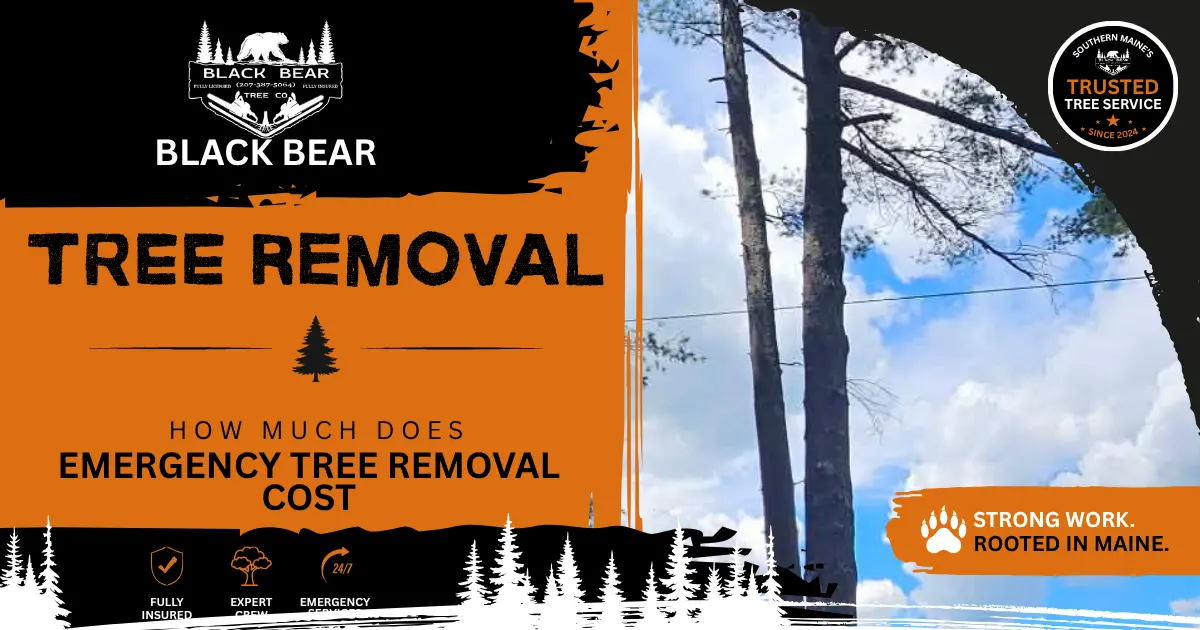
Emergency tree removal in Southern Maine generally costs between $650 and $2,700 or more, based on current Black Bear Tree Co. estimates.
Small emergency jobs commonly range from $650 to $1,300, medium emergency jobs from $1,300 to $2,000, and large or high-risk emergencies from $2,000 to $2,700 or more.
The final cost depends on much more than the tree’s height. The urgency of the situation, tree condition, property access, proximity to buildings, storm conditions, equipment requirements and amount of cleanup can all affect the estimate.
This guide explains:
- Average emergency tree-removal prices
- What qualifies as a tree emergency
- What affects emergency removal costs
- What to do immediately after a tree falls
- When homeowners insurance may help
- How fallen trees near power lines should be handled
- When cranes and specialized equipment are needed
- How to choose an emergency tree company
- How homeowners may reduce future storm damage
If a tree has fallen on your home, is blocking your driveway or appears likely to fall, keep everyone away from the area and contact Black Bear Tree Co.’s 24-hour emergency tree service in Southern Maine.
Call 207-387-5064 for urgent help or request an emergency tree-service estimate online.
Need Emergency Tree Removal Now?
Black Bear Tree Co. provides fast emergency response for fallen trees, dangerous limbs and storm-damaged trees throughout York and Cumberland counties.
- Licensed Maine arborist
- Fully insured tree company
- More than 10 years of tree-service experience
- Professional equipment for hazardous removals
- Crane-assisted removal available
- Storm cleanup and debris hauling
- Local Southern Maine crew
- 24-hour emergency service
Call 207-387-5064 or submit your emergency tree-service request.
If electrical wires are involved, do not approach the tree. Contact the utility company or emergency services first.
Average Emergency Tree Removal Cost in Southern Maine
Based on current pricing used by Black Bear Tree Co., estimated emergency tree-removal costs in Southern Maine are:
| Emergency job category | Typical situation | Estimated cost |
|---|---|---|
| Small emergency job | Smaller fallen tree, accessible broken limb or limited debris | $650–$1,300 |
| Medium emergency job | Larger tree, multiple damaged limbs or more complicated access | $1,300–$2,000 |
| Large or high-risk emergency | Tree on a structure, unstable large tree, extensive rigging or specialized equipment | $2,000–$2,700+ |
These figures are general planning estimates—not guaranteed quotes.

Some straightforward emergency jobs may fall near the lower end of the range. Large trees resting on houses, unstable storm-damaged trunks, difficult backyard removals and projects requiring a crane may exceed the typical range.
Emergency work is a separate category from scheduled tree removal in Southern Maine. It is not simply an automatic surcharge applied whenever a tree has storm damage.
An on-site or priority assessment is the best way to determine the actual cost. Request a fast estimate from Black Bear Tree Co.
What Qualifies as a Tree Emergency?
A tree problem becomes an emergency when it creates an immediate or rapidly developing risk to people, buildings, vehicles, utilities or essential access.
Common emergencies include:
- A tree that has fallen on a house, garage or other structure
- A large tree leaning toward an occupied building
- A broken limb hanging above a driveway, walkway or entrance
- A tree blocking the only driveway or access road
- A split trunk that may fail without warning
- A tree resting on another damaged tree
- Storm debris preventing emergency access
- A tree or branch entangled with utility wires
- A tree that shifted significantly during high winds
- Major root failure or lifting soil around a leaning tree
- A partially uprooted tree
- Heavy limbs resting on a roof
- A tree threatening vehicles, propane tanks or other property
A dead tree that is standing securely in an open area may need prompt attention without necessarily requiring an immediate after-hours response. However, the same tree leaning over a house or dropping large branches could be an emergency.
If you are unsure how serious the situation is, review the warning signs that a tree may need removal and arrange an evaluation through Black Bear’s Southern Maine arborist service.
What Affects Emergency Tree Removal Cost?
The Tree’s Size and Weight
Large trees produce heavier limbs, logs and debris. They may require more personnel, equipment and time to remove safely.
However, size alone does not determine the cost. A large tree that falls completely into an open yard may be easier to address than a smaller tree suspended over a roof or trapped between buildings.
For non-emergency planning, Black Bear’s 2026 tree-removal cost guide explains how size affects standard removal prices.
Where the Tree Landed
A tree lying in an open yard is different from a tree resting on:
- A house
- A garage
- A shed
- A deck
- A vehicle
- A fence
- Another tree
- Utility equipment
- A propane tank
- A septic area
Trees resting on structures must often be removed in carefully controlled sections. Cutting the wrong branch or trunk section can shift the tree’s weight and cause additional damage.
Tree Condition and Stability
Storm-damaged trees do not always respond normally when cut.
The trunk may be split, the root plate may be lifting, limbs may be under tension and the remaining wood may be supporting more weight than it appears to be. Dead or decayed sections can also break unexpectedly.
Hazards may include:
- Broken tops
- Hanging branches
- Cracked trunks
- Hollow areas
- Root failure
- Included bark
- Decay
- Multiple weak stems
- Bent or loaded branches
- Trees leaning against one another
- Storm-damaged neighboring trees
A professional assessment helps determine which portion can be removed first without causing an uncontrolled shift.
Property Access
Equipment access can significantly affect the removal plan.
A tree beside a wide driveway may be accessible to trucks and machinery. A tree behind a house, inside a fenced yard or down a steep embankment may require climbing, rigging and more manual handling.
Common access challenges include:
- Narrow driveways
- Fenced backyards
- Steep slopes
- Soft or saturated ground
- Snow and ice
- Septic systems
- Wells
- Retaining walls
- Landscape beds
- Buildings blocking equipment access
- Overhead utility lines
- Limited turnaround space
Black Bear’s tree-service project gallery shows examples of equipment and completed work in different property conditions.
Urgency and Response Time
A dangerous tree requiring immediate attention at night, during a storm or on a holiday can involve different scheduling and staffing requirements than work safely scheduled for the following day.
Emergency crews may need to respond while:
- Roads are obstructed
- Power is out
- Wind is continuing
- Rain or snow is falling
- Ground conditions are poor
- Multiple properties need urgent help
- Daylight is limited
If the situation can be secured safely and completed during daylight, the tree company may recommend a staged response. The immediate priority is controlling the hazard—not performing unnecessary work under dangerous conditions.
Equipment and Rigging Requirements
Emergency removal may require:
- Bucket trucks
- Climbing equipment
- Ropes and rigging systems
- Controlled lowering devices
- Cranes
- Specialized lifts
- Skid steers
- Chippers
- Log-hauling equipment
- Work-zone lighting
- Traffic-control equipment
Specialized equipment does not automatically make a project more expensive. The right machine can sometimes reduce labor, shorten the project and help prevent additional property damage.
For large trees, limited drop zones and removals over structures, Black Bear offers crane-assisted tree removal in Southern Maine.
Cleanup and Debris Removal
Emergency tree-removal estimates may include different levels of cleanup.
Ask whether the estimate includes:
- Cutting and removing the trunk
- Chipping branches
- Hauling logs
- Removing smaller debris
- Raking the immediate area
- Clearing the driveway
- Leaving firewood
- Removing damaged neighboring limbs
- Temporary hazard reduction
- Returning for final cleanup
After major weather events, storm cleanup in Southern Maine may include fallen-tree removal, branch cleanup, chipping and debris hauling.
Stump Grinding
Emergency removal usually focuses on eliminating the immediate hazard. The stump and root system may remain after the tree is removed.
Stump grinding normally uses different equipment and is often quoted separately. Once the emergency has been resolved, Black Bear can provide professional stump grinding in Southern Maine.
Homeowners can also review the 2026 stump-grinding cost guide for planning information.
Why Emergency Tree Removal Costs More Than Routine Removal
Emergency work can cost more because the tree is already unstable, access may be limited and the crew may need to respond immediately.
Additional considerations may include:
- Priority scheduling
- After-hours deployment
- Hazardous weather
- A tree resting on a building
- Suspended branches or trunks
- Limited visibility
- Specialized rigging
- Crane requirements
- Utility coordination
- Extensive debris
- Additional personnel
- Work-zone control
- Multiple damaged trees
Routine removal allows a company to inspect the tree, schedule equipment and prepare the work zone under normal conditions. An emergency can require those decisions to be made quickly while the tree is actively threatening the property.
That does not mean every storm-damaged tree automatically receives emergency pricing. If the hazard can be isolated safely and the work scheduled normally, the company may treat it as a standard tree-removal project.
What to Do Immediately After a Tree Falls
1. Make Sure Everyone Is Safe
Move people and pets away from the tree and surrounding area.
Do not stand beneath hanging branches or walk around a partially uprooted tree. Additional limbs may fall without warning, and the trunk may shift as wind or weight changes.
2. Check for Power Lines From a Distance
Never touch a fallen wire, a tree touching a wire or anything in contact with that tree.
Maine emergency guidance advises residents to contact the local power company when trees are entangled with power lines. Even a disconnected-looking wire can remain energized or receive electricity from another source.
Price is only one concern after a tree emergency. Our guide to emergency tree cleanup in Southern Maine explains how to secure the area, document damage, contact the appropriate utility or insurer, and arrange safe cleanup.
The State of Maine’s tree-debris safety guidance recommends professional assessment rather than attempting to remove downed trees or branches yourself. OSHA similarly advises treating downed or damaged lines as energized and staying clear of connected trees and limbs in its winter-weather electrical-hazard guidance.
3. Call 911 When There Is an Immediate Threat
Call emergency services if:
- Someone is injured
- A tree caused a fire
- A tree damaged utility equipment
- A tree blocks a public road
- A structure appears unsafe to occupy
- There is an immediate threat to life
A tree company should not replace emergency responders when there is a fire, injury, electrical hazard or unsafe building.
4. Prevent People From Entering the Area
Keep family members, neighbors and pets out of the work zone.
Do not allow anyone to climb on the tree, cut branches or attempt to move debris with a vehicle. A trunk under tension can roll or release suddenly.
5. Photograph the Damage When It Is Safe
Take photographs and videos from a safe distance before work begins, provided doing so does not put you near unstable trees, damaged buildings or power lines.
Document:
- The entire tree
- Where the tree originated
- Damage to the house or structure
- Broken branches
- The root system
- Vehicles or personal property affected
- Nearby utility lines
- Access conditions
- Visible interior damage
These images may help your insurer evaluate the claim. Do not delay urgent hazard control solely to take photographs.
6. Contact Your Insurance Company
Notify your insurance carrier promptly when a tree damages an insured structure or personal property.
Ask:
- Whether the event may be covered
- Whether emergency mitigation can begin immediately
- What documentation is required
- Whether an adjuster must inspect the damage
- Whether there are debris-removal limits
- Whether temporary repairs are covered
- How contractor estimates should be submitted
Coverage varies by policy, cause of loss and circumstances. Black Bear Tree Co. can provide an estimate for tree work, but the insurance company determines coverage.
7. Contact an Emergency Tree Company
Explain:
- Your name and address
- What happened
- Whether anyone is injured
- Whether wires are involved
- What the tree is resting on
- Whether the driveway is blocked
- Whether the structure is occupied
- Approximate tree size
- Whether the tree is still moving
- Whether you can send photographs
Contact Black Bear’s Southern Maine emergency tree-service team or send an emergency service request.
What Not to Do After a Tree Falls
Do not:
- Walk under hanging limbs
- Climb onto the fallen tree
- Use a chainsaw without appropriate training
- Cut a bent or loaded branch
- Pull the tree with a personal vehicle
- Touch or approach utility wires
- Enter a severely damaged structure
- Allow children or pets into the area
- Hire an uninsured person without verifying credentials
- Assume the remaining portion of the tree is stable
- Wait beneath the tree for a contractor to arrive
Storm cleanup can expose workers and homeowners to electrical hazards, falls, falling limbs, chainsaws and unstable wood. OSHA states that disaster cleanup should be handled by people with the proper training, equipment and experience in its storm-recovery safety guidance.
Does Homeowners Insurance Cover Emergency Tree Removal?
Homeowners insurance may cover emergency tree removal when a covered event causes a tree to damage an insured structure.
For example, coverage may be available when wind causes a tree to fall onto:
- A house
- A garage
- A covered shed
- A fence
- Another insured structure
Some policies may provide limited debris-removal coverage when a tree blocks a driveway or accessibility route, even without structural damage. Other policies may only cover removal when an insured structure is damaged.
Coverage may depend on:
- What caused the tree to fall
- What the tree damaged
- The condition of the tree before the event
- Policy exclusions
- Debris-removal limits
- Deductibles
- Whether the tree belonged to you or a neighbor
- Whether emergency mitigation was reasonable and necessary
FEMA advises insured homeowners with widespread fallen-tree debris to review their policies because many policies provide some debris-removal coverage. See FEMA’s fallen-tree debris guidance.
Your insurer—not the tree company—makes the final coverage determination.
Will Insurance Pay If the Tree Did Not Damage Anything?
Often, insurance coverage is more limited when a tree falls into the yard without damaging an insured structure.
The cost may become the homeowner’s responsibility unless the policy includes specific coverage for blocked access, debris removal or another qualifying circumstance.
Call your insurance carrier and ask for a policy-specific explanation before assuming the work is or is not covered.
What If a Neighbor’s Tree Falls on My Property?
A neighbor’s tree falling on your property does not automatically mean the neighbor or the neighbor’s insurer must pay.
Claims can depend on:
- What caused the tree to fall
- Whether the tree was visibly hazardous beforehand
- Whether the owner knew about the danger
- What property was damaged
- Each homeowner’s insurance policy
- Applicable law and documented negligence
Contact your insurance company for guidance. If responsibility is disputed or the loss is significant, consider speaking with a qualified Maine attorney. A tree-service company can document tree conditions and perform the work, but it cannot determine legal liability.
Should I Wait for an Insurance Adjuster Before Removing the Tree?
Safety comes first.
If the tree is creating an immediate hazard or allowing additional damage, your insurer may expect reasonable steps to protect the property. However, claim procedures vary.
When possible:
- Call the insurer.
- Ask whether emergency mitigation is authorized.
- Photograph the damage safely.
- Save estimates, invoices and communications.
- Avoid permanent building repairs until the insurer explains its inspection requirements.
Do not leave people exposed to a dangerous tree solely because an adjuster has not arrived. Contact Black Bear through the free-estimate and emergency request page so the hazard can be evaluated.
How Emergency Tree Removal Works
Step 1: Initial Information
The tree company gathers details about the location, hazard, structures, utilities and access.
Photographs can be helpful, but they do not always replace an on-site inspection.
Step 2: Hazard Assessment
The crew evaluates:
- Tree stability
- Trunk and root damage
- Hanging limbs
- Load and tension
- Nearby structures
- Utility hazards
- Escape routes
- Equipment access
- Ground conditions
- Weather
Maine classifies felling trees in developed areas and evaluating tree conditions as arboriculture work requiring appropriate licensing. The Maine Department of Agriculture, Conservation and Forestry explains the state’s arborist licensing and insurance requirements.
Black Bear Tree Co. is owned by Chris, a licensed Maine arborist with more than 10 years of industry experience.
Step 3: Stabilizing the Work Area
Before removal begins, the crew may:
- Establish a work zone
- Restrict property access
- Coordinate with utility personnel
- Remove small hazards
- Position equipment
- Install ropes or rigging
- Protect structures
- Determine the removal sequence
Step 4: Controlled Removal
The safest approach depends on how the tree fell.
The crew may remove branches first, cut the trunk into sections, use rigging to control loads or use a crane to lift tree sections away from the structure.
For especially complicated projects, learn how crane tree removal can help manage large or inaccessible trees.
Step 5: Cleanup and Access Restoration
Once the hazard is controlled, the crew can chip branches, move logs, clear the driveway and remove debris according to the approved scope.
More extensive property cleanup may be completed through Black Bear’s storm-damage cleanup service.
Step 6: Follow-Up Tree Inspection
A major storm can damage more than one tree.
After the immediate emergency is resolved, inspect nearby trees for:
- New leans
- Lifted soil
- Cracks
- Broken tops
- Hanging branches
- Split unions
- Root damage
- Trees newly exposed to wind
- Branches damaged by the fallen tree
Black Bear’s licensed arborist service can help identify additional risks.
When Is Crane-Assisted Emergency Removal Needed?
A crane may be recommended when:
- A large tree is resting on a house
- The trunk cannot be dropped safely
- Branches are suspended above a structure
- There is no usable drop zone
- The tree is inaccessible to ordinary equipment
- The remaining trunk is highly unstable
- Large sections must be lifted rather than lowered
- Multiple buildings surround the tree
- Conventional rigging would create unnecessary risk
A crane does not automatically mean the job will cost more. In the right situation, it can reduce manual cutting, limit additional property damage and shorten the removal process.
Read more about crane-assisted tree removal in Southern Maine and view examples in Black Bear’s tree-service gallery.
Can a Fallen Tree Be Trimmed Instead of Removed?
Sometimes only the damaged portion needs to be removed.
Professional tree trimming in Southern Maine may be appropriate when:
- The trunk remains stable
- Root damage is limited
- Damage affects only a few branches
- The tree retains a viable canopy
- The remaining structure can be managed safely
- Pruning will not leave the tree badly unbalanced
Complete removal may be recommended when:
- The tree is uprooted
- The trunk is split
- Major roots have failed
- Most of the canopy is destroyed
- The tree is resting on a structure
- Severe decay contributed to the failure
- The remaining tree cannot be made reasonably safe
If you are deciding between removal and pruning, compare the tree-removal cost guide with the tree-trimming cost guide.
Can Emergency Tree Damage Be Prevented?
No tree-care plan can prevent every failure. Healthy trees can be damaged by severe wind, heavy snow, ice and saturated soil.
However, routine inspection and maintenance may help identify certain preventable risks before the next storm.
Consider scheduling an inspection if you notice:
- Dead limbs over a roof or driveway
- Cracks in the trunk
- Cavities
- Mushrooms or other fungal growth
- A worsening lean
- Exposed or damaged roots
- Multiple competing trunks
- Weak branch attachments
- Repeated limb failure
- Peeling or missing bark
- Storm damage that was never evaluated
FEMA recommends trimming damaged trees and removing dead branches near homes as part of storm preparation. See FEMA’s 2026 winter-storm preparation guidance.
Black Bear provides preventive tree trimming and pruning as well as evaluations through its Southern Maine arborist service.
How to Choose an Emergency Tree-Removal Company
Before authorizing work, verify:
- Maine arborist licensing
- General liability insurance
- Workers’ compensation coverage
- Experience with storm-damaged trees
- Experience working near structures
- Appropriate equipment
- Crane and rigging capabilities when required
- Clear communication
- Written scope and pricing
- Cleanup and hauling details
- Local references or reviews
- Who is responsible for building repairs
- Whether stump grinding is included or separate
An unusually low price may exclude cleanup, hauling, equipment or other work you expected.
Learn more about Black Bear Tree Co.’s owner and qualifications, explore the company’s complete Southern Maine tree services or review real project photos.
Questions to Ask Before Approving an Emergency Estimate
Ask:
- What portion of the tree will be removed?
- Is the remaining tree safe?
- Does the price include debris removal?
- Will logs be hauled away or left on-site?
- Is crane work included?
- Is stump grinding included?
- Could the price change once work begins?
- Will the driveway or entrance be reopened?
- Are neighboring trees also damaged?
- Is a return visit required?
- What documentation will I receive?
- Can the estimate be submitted to my insurer?
Clear expectations help prevent misunderstandings after the emergency is resolved.
Emergency Tree Service Throughout Southern Maine
Black Bear Tree Co. provides emergency tree removal, storm cleanup and related tree services throughout York and Cumberland counties.
Local service areas include:
- Tree services in Limerick, Maine
- Emergency tree service in Limerick, Maine
- Tree service in Waterboro, Maine
- Tree service in Buxton, Maine
- Tree service in Sanford, Maine
- Tree removal in Sanford, Maine
- Storm cleanup in Sanford, Maine
- Tree service in Gorham, Maine
- Tree-removal warning signs in Gorham, Maine
- Tree-removal costs in Gorham, Maine
- Tree service in Standish, Maine
- Tree service in Portland, Maine
- Tree service in Scarborough, Maine
- Tree service in Kennebunk, Maine
- Tree service in Biddeford, Maine
- Tree service in Saco, Maine
- Tree service in Windham, Maine
Black Bear also serves homeowners and property owners in Limington, Cornish, Newfield, Shapleigh, Parsonsfield, Hollis, Dayton, Alfred and surrounding Southern Maine communities.
If your town is not listed, contact Black Bear Tree Co. to confirm emergency availability.
Get an Emergency Tree Removal Estimate
Online prices can help you understand the likely range, but emergency tree removal must be evaluated individually.
Black Bear Tree Co. will consider:
- The tree’s size and condition
- What the tree is resting on
- Immediate safety hazards
- Property access
- Utility involvement
- Required equipment
- Rigging or crane needs
- Cleanup and hauling
- Whether additional trees are damaged
For urgent service, call 207-387-5064.
You can also request an emergency tree-removal estimate online or visit the complete emergency tree-service page.
Frequently Asked Questions
How much does emergency tree removal cost in Southern Maine?
Emergency tree removal in Southern Maine generally costs $650 to $2,700 or more, based on current Black Bear Tree Co. estimates. Small emergency jobs typically range from $650 to $1,300, medium jobs from $1,300 to $2,000, and large or high-risk emergencies from $2,000 to $2,700 or more.
What affects emergency tree removal cost in Southern Maine?
Important factors include tree size, tree condition, where the tree landed, proximity to structures, property access, urgency, weather, rigging requirements, specialized equipment and the amount of cleanup requested.
Why is emergency tree removal more expensive?
Emergency removal may require priority scheduling, an after-hours response, additional personnel, hazardous-condition work, controlled rigging, crane assistance or careful removal from a structure. Not every storm-damaged tree automatically requires emergency pricing.
Does homeowners insurance cover emergency tree removal?
Insurance may cover removal when a covered event causes a tree to damage an insured structure. Some policies may also provide limited coverage for debris removal or blocked access. Coverage depends on the individual policy and circumstances, so contact your insurer.
Should I call my insurer or a tree company first?
Call emergency services first if someone is injured, a fire has started, wires are down or the structure is unsafe. For property damage without an immediate life-safety emergency, contact your insurer and an emergency tree company as soon as practical.
Should I wait for an adjuster before removing a dangerous tree?
Do not leave people exposed to an immediate hazard. Ask the insurer whether emergency mitigation can begin, photograph the damage when safe and save all estimates and invoices. Claim requirements vary by insurer.
What should I do if a tree is touching a power line?
Stay away from the tree and wire. Treat every wire as energized and contact the utility company or emergency services. Do not attempt to cut or move the tree.
Can Black Bear remove a tree from a house?
Black Bear Tree Co. handles hazardous tree removals near and on structures. The safest plan may involve controlled rigging, sectional removal or crane assistance depending on the tree and property.
Is crane-assisted removal always more expensive?
Not necessarily. A crane can sometimes make a difficult removal faster and more controlled. Pricing depends on the overall project, not simply whether a crane is used.
Is cleanup included with emergency tree removal?
The included cleanup depends on the estimate. Ask whether chipping, hauling, log removal, raking and access restoration are included before approving the work.
Is stump grinding included?
Stump grinding is normally separate because it requires different equipment and is not always necessary during the emergency response. Ask for it to be included if you want the stump addressed after removal.
Can a storm-damaged tree be saved?
Sometimes. A tree with limited branch damage and a stable trunk and root system may be preserved through professional pruning. A severely split, uprooted or structurally unstable tree is more likely to require removal.
How quickly can Black Bear Tree Co. respond?
Black Bear prioritizes dangerous situations involving fallen trees, blocked access and threats to structures. Response time depends on location, weather, road conditions, crew availability and the number of active emergencies.
Is Black Bear Tree Co. licensed and insured?
Yes. Black Bear Tree Co. is operated by a licensed Maine arborist and is fully insured for professional tree work.
Does Black Bear Tree Co. provide free estimates?
Yes. Black Bear provides free estimates for emergency tree removal and related services throughout Southern Maine. Request an estimate online or call 207-387-5064.
Emergency Tree Removal Help When You Need It Most
When a fallen or unstable tree threatens your home, vehicle, driveway or other structure, getting a safe response matters more than guessing the final price. The emergency tree removal cost in Southern Maine depends on the size and condition of the tree, where it landed, property access and the equipment needed to control the hazard.
Black Bear Tree Co. provides 24-hour emergency service backed by a licensed Maine arborist, professional equipment and more than 10 years of experience. If you need an accurate emergency tree removal cost in Southern Maine, call 207-387-5064 or request a free estimate online.
Get a Clear Price Before Work Begins
The emergency tree removal cost in Southern Maine can vary considerably because every fallen or unstable tree creates different challenges. Black Bear Tree Co. will assess the hazard, explain the recommended removal plan and provide a clear estimate before beginning the work whenever conditions allow.
Local Emergency Tree Service Across Southern Maine
Black Bear Tree Co. responds to storm-damaged, fallen and hazardous trees throughout York and Cumberland counties. For an accurate emergency tree removal cost in Southern Maine, call 207-387-5064 or request a free estimate online.