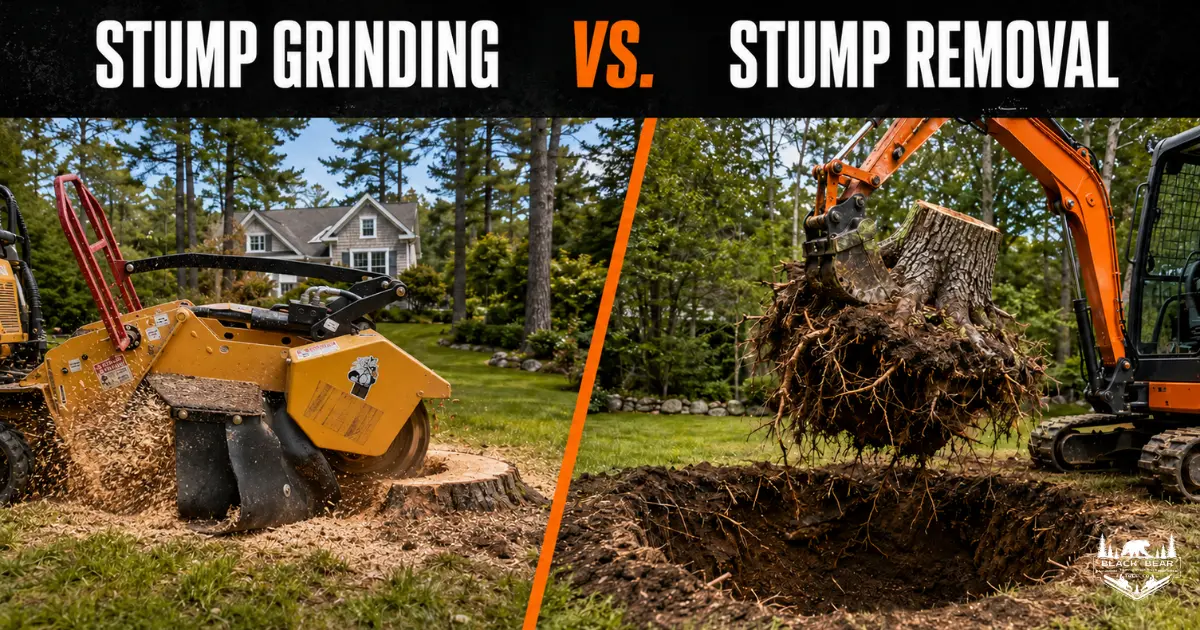
Stump Grinding vs. Stump Removal: Which Is Better for Your Property?
Learn how the two methods differ, what happens to the roots, and which solution makes sense for your yard.
Fully Insured • Local Maine Company • Free Estimates
Get My Free Estimate
Call 207-387-5064
Stump Grinding vs. Stump Removal: Which Is Better?
After a tree is cut down, you still need to decide what to do with the remaining stump. Should it be ground below the surface or completely excavated with its root ball?
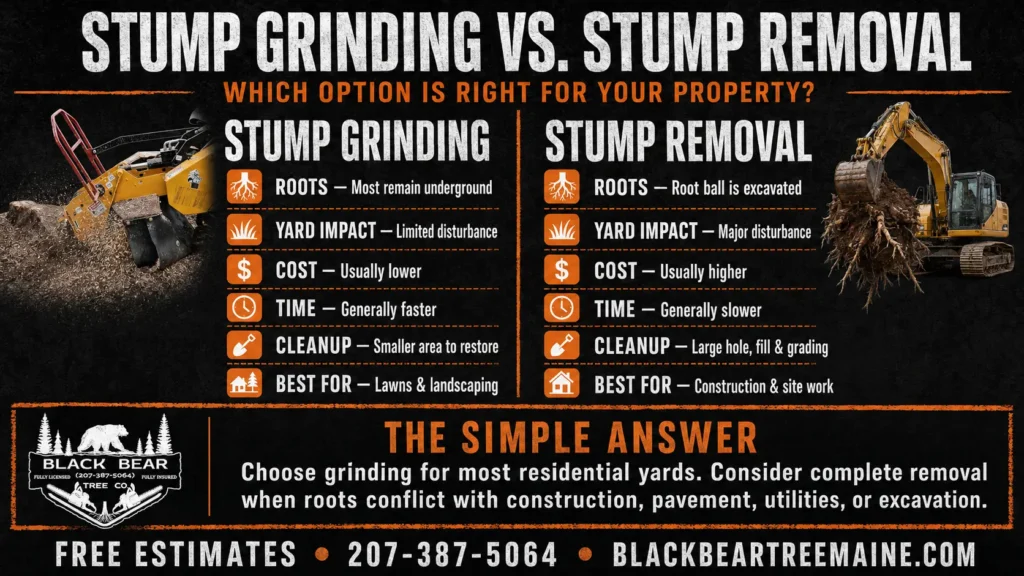
When comparing stump grinding vs. stump removal, stump grinding is usually the better choice for residential properties. It is generally faster, more affordable, and less disruptive to the surrounding lawn. Complete stump removal may be necessary when the stump and major roots interfere with construction, excavation, utilities, pavement, or another permanent improvement.
The right option depends on:
- How you plan to use the area
- The stump’s size and species
- Equipment access
- The location of underground utilities
- Nearby buildings, pavement, septic systems, and landscaping
- Whether major roots must be physically removed
- How much ground disturbance is acceptable
- Your project budget
Black Bear Tree Co. provides professional stump grinding throughout Southern Maine and can evaluate the stump, surrounding property, and your plans for the site.
For an onsite recommendation, request a free estimate or call Black Bear Tree Co. at 207-387-5064.
What Is Stump Grinding?
Stump grinding uses specialized equipment with a rotating cutting wheel to reduce the stump and immediate root flare into small wood chips.
The stump is typically ground below the surrounding grade. The resulting depression can then be cleared of excess grindings, filled with suitable soil, leveled, and prepared for grass or landscaping.
Stump grinding does not normally remove the entire underground root system. Most roots remain beneath the soil and gradually decay over time.
Professional Southern Maine stump grinding is commonly used to:
- Eliminate visible stumps
- Reduce tripping and mowing hazards
- Improve curb appeal
- Restore usable lawn space
- Prepare an area for grass or a garden bed
- Address stumps left after tree removal
- Reduce property disturbance
- Avoid excavating a large root ball
If price is an important part of your decision, read our complete Stump Grinding Cost in Southern Maine guide.
What Is Complete Stump Removal?
Complete stump removal involves excavating the stump, root ball, and as much of the major root system as the project requires.
Depending on the stump, this may require an excavator, backhoe, skid steer, or other heavy equipment. Large roots may need to be cut, pulled, or dug out individually.
This method creates considerably more disturbance than grinding. Removing a mature root ball can leave a large hole that must be filled, compacted, graded, and sometimes supplemented with additional soil.
Complete removal is most often considered when:
- A foundation will be installed
- A driveway or parking area will cross the site
- A patio, walkway, or retaining wall is planned
- Major roots conflict with underground construction
- The area must be excavated or regraded
- Root material cannot remain beneath the proposed improvement
- The stump is part of a larger lot-clearing project
- The property is being prepared for construction
Black Bear Tree Co. can evaluate whether ordinary grinding will accomplish your goal or whether the project requires more extensive excavation or site preparation.
Stump Grinding vs. Stump Removal at a Glance
| Consideration | Stump grinding | Complete stump removal |
|---|---|---|
| Visible stump | Ground below grade | Removed |
| Root ball | Remains underground | Excavated |
| Most roots | Remain and decay naturally | Major roots may be excavated |
| Yard disturbance | Relatively limited | Substantial |
| Hole created | Usually moderate | Often large |
| Equipment requirements | Stump grinder | Excavator or other heavy equipment may be needed |
| Typical project time | Generally faster | Generally slower |
| Relative cost | Usually less expensive | Usually more expensive |
| Lawn restoration | Usually straightforward | More filling, compacting, and grading may be required |
| Construction preparation | May not be sufficient | Often more appropriate |
| Best use | Lawns and ordinary landscaping | Construction and major site work |
Which Option Costs Less?
Stump grinding is usually less expensive than complete stump removal.
Grinding focuses on the visible stump and immediate root flare rather than excavating the entire root ball. That typically means:
- Less machine time
- Less labor
- Less soil disturbance
- A smaller area to restore
- Less material to haul away
- Less backfill and grading
Complete stump removal can cost more because it may require heavy excavation equipment, additional labor, hauling, new fill, compaction, and more extensive property restoration.
For current grinding ranges and the factors affecting an estimate, see our 2026 stump grinding cost guide.
The cost of either option can be affected by:
- Stump diameter
- Root-flare width
- Tree species
- Wood density
- Number of stumps
- Surface roots
- Rocks and embedded objects
- Equipment access
- Underground utilities
- Nearby pavement or structures
- Grinding or excavation depth
- Cleanup requirements
- Hauling and disposal
- Final grading and restoration
The only reliable way to price the work is to evaluate the actual site. Request a free stump estimate to receive project-specific recommendations.
How Much Does Stump Removal Cost in Maine?
Complete stump removal generally costs more than stump grinding because the stump and major root mass must be physically excavated rather than simply ground below grade.
The cost of stump removal in Maine depends on several factors, including the stump’s diameter, tree species, root-ball size, soil conditions, rocks and ledge, equipment access, nearby structures, disposal requirements, and how much site restoration is needed afterward.
Southern Maine properties can make complete removal especially unpredictable. Large roots growing through rocky soil or around buried obstacles may require considerably more excavation than a similar-sized stump in open, loose soil.
That’s why there isn’t one reliable flat price for stump removal in Maine. An on-site evaluation is usually the best way to determine what the work will actually involve.
If your primary goal is simply to eliminate the visible stump, restore your lawn, remove a tripping hazard, improve curb appeal, or make mowing easier, Black Bear’s stump grinding services in Southern Maine are generally the more economical and less disruptive solution.
For homeowners comparing prices, our 2026 stump grinding cost guide explains how stump diameter, root flare, tree species, access, terrain, rocks, grinding depth, cleanup, and the number of stumps can affect the final price. Many residential stump-grinding projects fall between approximately $100 and $700 per stump, while unusually large or complicated stumps may cost more.
Complete stump removal becomes more appropriate when the underground stump or root mass conflicts with a planned foundation, driveway, utility, excavation, or other construction project.
If you’re removing multiple trees and stumps while preparing a larger area, see our lot clearing services in Southern Maine and our Land Clearing Cost in Maine: 2026 Pricing Guide to understand how tree density, stumps, brush, equipment access, terrain, debris removal, and other site conditions can affect a larger clearing project.
Why Is Stump Removal More Expensive Than Stump Grinding?
The difference comes down to how much work is required below ground.
With stump grinding, specialized equipment reduces the visible stump and immediate root flare below the surrounding grade while leaving most of the underground root system in place.
Complete stump removal can require substantially more work, including:
- Excavating around the stump
- Exposing major roots
- Cutting or breaking large roots
- Extracting the stump and root ball
- Moving and disposing of heavy material
- Backfilling the resulting hole
- Repairing disturbed portions of the property
A mature Maine tree can leave behind a substantial root system, so complete extraction can turn what looks like a relatively simple stump project into a much larger excavation job.
That’s why stump grinding is usually the better value for Maine homeowners who simply want to reclaim their lawn or landscaping.
When Is Paying for Complete Stump Removal Worth It?
Despite the additional cost, complete stump removal can be worth considering when:
- A foundation will be installed where the stump sits
- A driveway or other hardscape will cross the area
- Major excavation is already planned
- Large roots interfere with utilities or construction
- A contractor requires the stump and root ball to be removed
- You need the underground area cleared rather than simply eliminating the visible stump
If the stump was left behind after a recent tree removal, it’s also worth comparing the complete project cost. Our Tree Removal Cost in Southern Maine: 2026 Guide explains how tree size, location, condition, equipment requirements, and stump work can affect the overall cost of removing a tree from your property.
Call 811 Before Excavating Around a Stump
Complete stump removal involves significantly more ground disturbance than ordinary stump grinding. Before digging or excavating, underground utilities need to be identified.
The Maine Public Utilities Commission’s Dig Safe guidance explains Maine’s requirements for notifying Dig Safe before certain excavation work. You can also contact Dig Safe by calling 811 before digging.
Remember that utility marking may not identify every privately owned line on a property. Tell your contractor about known private utilities, septic components, irrigation, propane lines, landscape wiring, or other underground features near the stump.
Stump Grinding vs. Stump Removal Cost
When comparing stump grinding vs. stump removal, cost is one of the biggest differences for Maine homeowners.
Stump grinding is generally the less expensive option because the stump is ground below grade while most of the underground root system remains in place. Complete stump removal requires significantly more excavation, labor, equipment, and property restoration because the stump and major root mass are physically removed.
Here’s how the two options compare:
| Factor | Stump Grinding | Stump Removal |
|---|---|---|
| Typical cost | $$ | $$$ |
| Visible stump removed | ✓ Yes | ✓ Yes |
| Major roots removed | No | ✓ Yes |
| Excavation required | Minimal | Significant |
| Lawn disruption | Lower | Higher |
| Hole left behind | Smaller | Much larger |
| Cleanup required | Lower | Higher |
| Good for restoring lawn | ✓ Excellent | Usually unnecessary |
| Good for landscaping | ✓ Excellent | Depends on project |
| Replanting in exact location | Usually not ideal | More practical |
| Construction footprint | Sometimes | ✓ Often better |
| Best for most homeowners | ✓ Yes | Only when necessary |
Which Option Is More Affordable?
For most residential properties, stump grinding is more affordable than complete stump removal.
Black Bear’s 2026 stump grinding cost guide estimates many residential stump-grinding projects at approximately $100–$700 per stump, although very large, difficult, or inaccessible stumps can cost more.
Several factors can affect the final price, including:
- Stump diameter
- Tree species
- Root flare and surface roots
- Number of stumps
- Equipment access
- Rocks and ledge
- Terrain
- Grinding depth
- Cleanup and chip removal
Complete removal can cost more because the project doesn’t end when the visible stump disappears. The root ball may need to be excavated, major roots cut, material removed, the resulting hole backfilled, and the disturbed area restored.
If the stump is left from a tree you’re currently planning to remove, our Tree Removal Cost in Southern Maine: 2026 Guide explains why stump grinding is typically quoted separately from the tree removal itself.
Does the Cheapest Option Always Make the Most Sense?
Not necessarily.
If you’re simply trying to restore your lawn, improve landscaping, eliminate a tripping hazard, or make mowing easier, paying extra to excavate the entire root system usually provides little additional benefit.
That’s why professional stump grinding in Southern Maine is the practical choice for many residential properties.
However, if you’re preparing the area for a foundation, driveway, garage, utility trench, or significant excavation, leaving a large stump and root system underground may create problems later.
For larger projects involving multiple trees, brush, and stumps, our Land Clearing Cost in Maine: 2026 Pricing Guide explains how stump work fits into the overall cost of preparing a property.
Stump Grinding vs. Stump Removal: The Cost Bottom Line
For most Maine homeowners:
Stump grinding = lower cost + less disruption + faster lawn recovery.
Complete stump removal = higher cost + more excavation + complete removal of the major root mass.
If you’re only trying to get rid of an unwanted stump, grinding will usually provide the result you need without paying for unnecessary excavation.
If you’re building or excavating where the stump currently sits, complete removal may justify the additional expense.
The best choice ultimately depends on what you plan to do with the space afterward.
Is Stump Grinding Better for Your Lawn?
In most residential yards, yes.
Stump grinding limits the work to the stump and surrounding root flare. Equipment still needs to reach the work area, but the process generally avoids the large excavation created by pulling out a mature root ball.
After grinding, the area can usually be restored by:
- Removing excess wood chips.
- Allowing for settling when necessary.
- Adding suitable topsoil.
- Leveling the area.
- Applying grass seed.
- Watering and maintaining the repaired area.
Complete removal creates a larger hole and may disturb a broader section of lawn. The area may require additional soil, mechanical compaction, grading, and drainage correction before it can be restored.
Tell us how you want the property to look afterward when you request your estimate. That helps determine the appropriate grinding depth and cleanup plan.
Does Stump Grinding Remove the Roots?
No. Standard stump grinding does not remove the entire underground root system.
The machine reduces the central stump and immediate root flare below grade. Most deeper and farther-reaching roots remain in the ground and gradually decompose.
This is acceptable for many projects because roots no longer grow outward after the tree is dead. However, remaining roots can take years to break down, and soil may settle as decomposition occurs.
Certain tree species may also produce new shoots from surviving roots. If a stump or nearby roots are actively sprouting, mention it during your estimate.
Complete stump removal can remove the root ball and selected major roots, but removing every small root from a mature tree is generally impractical. Tree roots can extend far beyond the original trunk.
Will Grinding Stop the Tree From Growing Back?
Grinding prevents regrowth from many stumps, but the outcome depends on the tree species, stump condition, remaining roots, and grinding depth.
Some species are more likely to send up root suckers after the main trunk has been removed. These shoots may appear away from the original stump because they grow from the surviving root system.
Follow-up options may include:
- Repeatedly removing new shoots
- Additional root grinding where practical
- Monitoring the area for regrowth
- Species-appropriate treatment performed according to product labels and applicable requirements
Do not apply household chemicals, fuel, salt, or unapproved substances to a stump. These methods can contaminate soil, damage surrounding plants, and create unnecessary safety risks.
How Long Do Remaining Roots Take to Decay?
Root decomposition can take several years and varies based on:
- Tree species
- Root diameter
- Soil moisture
- Soil temperature
- Drainage
- Microbial activity
- The stump’s age and condition
Large hardwood roots generally take longer to decompose than small roots from softer wood.
The University of Maine Cooperative Extension notes that tree stumps take time to decompose and that there are few proven shortcuts other than grinding. Its guidance does not support relying on “magic” stump-decay products as a dependable substitute for mechanical removal. (University of Maine Cooperative Extension)
If predictable soil conditions are essential for a foundation, driveway, or other permanent construction, leaving substantial woody material underground may not be appropriate.
Can You Plant Another Tree in the Same Spot?
It is generally better to plant a replacement tree beside the former location rather than directly in the center of the ground stump.
The original location may contain:
- Remaining structural roots
- Wood chips
- Decomposing wood
- Settling soil
- Restricted space for a new root system
- Possible disease concerns
- Different moisture and nutrient conditions
Moving the replacement tree away from the old stump generally provides a better planting environment.
If the previous tree was removed because of a suspected disease, have the situation evaluated before planting another susceptible tree nearby. Some pathogens can persist in stumps and root material.
Black Bear Tree Co. can also help determine whether nearby trees need professional trimming, monitoring, or removal.
Which Option Is Better Before Construction?
Complete stump and root excavation is often the safer choice when permanent construction will occupy the area.
A ground stump may leave substantial wood beneath the surface. As that material decomposes, the surrounding soil can settle. That may create problems beneath:
- Foundations
- Concrete slabs
- Driveways
- Patios
- Walkways
- Retaining walls
- Utility trenches
- Permanent sheds
- Fences
- Parking areas
Standard grinding may be sufficient for grass or shallow landscaping, but it should not automatically be treated as complete site preparation.
If your project includes clearing a larger area, Black Bear Tree Co. can discuss Southern Maine lot clearing, brush clearing, and related tree work.
Explain your construction plans before the stump is ground. Grinding first and discovering later that complete excavation was required can create unnecessary work.
Which Option Is Better Near a House or Driveway?
Grinding is often less disruptive near existing structures, but every site must be evaluated individually.
Important considerations include:
- Foundation location
- Driveway or walkway edges
- Underground power
- Propane or gas lines
- Water and well lines
- Septic tanks and leach fields
- Irrigation systems
- Invisible pet fences
- Landscape lighting
- Drainage systems
- Private communication lines
- Equipment clearance
- Potential for thrown debris
Complete root removal beside a foundation or driveway can cause extensive disturbance and may affect surrounding soil. Grinding may be preferable when the goal is simply to remove the visible stump without excavating beneath an existing improvement.
However, grinding depth may be limited when utilities, pavement, or structural components are nearby.
Do Utilities Need to Be Located?
Yes. Underground utilities and privately owned lines can affect both grinding and excavation.
The Maine Public Utilities Commission’s Dig Safe guidance states that anyone using power equipment to penetrate the ground must pre-mark the excavation area, contact 811 three business days in advance, and notify nonmember facility owners when applicable.
Dig Safe member utilities do not necessarily locate privately owned lines.
Tell us about:
- Septic systems
- Private electrical lines
- Propane lines
- Irrigation
- Invisible dog fences
- Well lines
- Drainage
- Landscape lighting
- Internet or communication lines
- Any other underground installations
Never assume a utility is deeper than the proposed work area.
What Happens to the Wood Chips?
Stump grinding produces a mixture of wood chips, stump material, soil, and small stones. A large stump may produce significantly more material than expected.
Depending on your agreement, the grindings may be:
- Left onsite
- Consolidated into a pile
- Used to partially fill the depression
- Removed from the immediate work area
- Hauled away as an additional service
Avoid planting grass directly into a thick layer of fresh grindings. Remove excess wood material and use appropriate topsoil to finish the area.
Pure, uncontaminated wood chips may sometimes be useful as surface mulch, but stump grindings mixed with soil and debris are not the same as finished landscaping mulch.
Can Surface Roots Be Ground?
Many exposed surface roots can be ground when access and surrounding conditions allow.
Surface-root grinding may be helpful when roots:
- Create mowing hazards
- Cross a lawn
- Interfere with landscaping
- Remain attached to a previously removed tree
- Prevent the area from being leveled
Every additional root increases the total grinding area. Point out all roots you want included during the estimate.
Roots belonging to a living tree should not be ground without evaluating how their removal could affect the tree’s health and stability. If the roots belong to a tree you want to preserve, consider a professional tree evaluation first.
When Should You Choose Stump Grinding?
Stump grinding is generally the best choice when:
- You want to restore the area to lawn
- The stump is a tripping hazard
- You need easier mowing access
- You want to improve curb appeal
- The roots do not interfere with construction
- You want less yard disturbance
- You want a faster solution
- You want to reduce the project cost
- The stump remains after residential tree removal
- You do not need the complete root ball excavated
For most Southern Maine homeowners, grinding provides the most practical balance of cost, speed, appearance, and property protection.
When Should You Consider Complete Stump Removal?
More extensive excavation may be appropriate when:
- A foundation will occupy the site
- The area must be excavated for utilities
- Major roots conflict with construction
- A driveway or permanent hardscape is planned
- Root material cannot remain underground
- Significant grading is required
- The stump is part of comprehensive land preparation
- A contractor or engineer requires root removal
- The site needs predictable compaction beneath a permanent improvement
Complete stump removal should be planned as part of the broader excavation or construction project, especially when engineering, drainage, or compaction requirements are involved.
Should You Rent a Stump Grinder?
DIY stump grinding may initially appear inexpensive, but homeowners should consider the full project.
Rental grinding can involve:
- Equipment rental
- Delivery or trailer costs
- Fuel
- Transportation
- Personal protective equipment
- Machine operation on uneven ground
- Utility identification
- Flying debris
- Rocks and embedded metal
- Equipment damage
- Cleanup
- Disposal of grindings
- Lawn damage
Rental machines may also be smaller than professional equipment, increasing the time required for large Maine hardwood stumps.
Stump grinders are powerful machines that can cause severe injuries or property damage. Professional service is generally the safer choice for large stumps or work near houses, roads, pavement, utilities, pets, and frequently used areas.
Black Bear Tree Co. provides fully insured professional stump grinding with equipment selected for the actual site.
How to Prepare for a Stump Evaluation
Before requesting an estimate:
- Identify every stump you may want addressed.
- Take one close picture of each stump.
- Take a wider picture showing equipment access.
- Measure gates and narrow passages.
- Clear movable furniture, toys, hoses, and decorations.
- Identify septic systems and private utilities.
- Point out all surface roots.
- Explain how you plan to use the area.
- Mention upcoming construction or landscaping.
- Decide whether you want grindings left or removed.
- Keep children and pets away from the work area.
Including several stumps during the same visit may be more cost-effective than scheduling separate projects.
Submit your details through our free tree-service estimate form or call 207-387-5064.
Stump Grinding After Tree Removal
Cutting down a tree and grinding its stump are typically treated as separate parts of a project.
Tree removal eliminates the trunk and canopy, but unless stump work is included in the estimate, the base may remain after the tree is removed.
When planning tree removal in Southern Maine, ask:
- Is stump grinding included?
- How deep will the stump be ground?
- Are surface roots included?
- Will the grindings remain onsite?
- Is hauling included?
- Who will add topsoil and seed?
- Can the equipment reach the stump?
- Do utilities need to be marked?
- Is the area intended for construction?
Combining services can reduce repeat equipment transportation and help ensure the final result matches your plans.
If the tree is unstable, storm-damaged, or threatening a structure, contact Black Bear Tree Co. for 24-hour emergency tree service before worrying about the stump.
Why Choose Black Bear Tree Co.?
Black Bear Tree Co. is a locally owned and fully insured Southern Maine tree-service company based in Limerick.
Customers choose us for:
- Free, straightforward estimates
- Professional stump-grinding equipment
- Experienced equipment operation
- Careful property access
- Multiple-stump service
- Cleanup options
- Residential and commercial work
- Tree removal and grinding coordination
- Service throughout York and Cumberland counties
- Friendly local communication
Learn more about Chris and Black Bear Tree Co., explore our tree-service gallery, or browse more Southern Maine tree-service tips.
Stump Grinding Service Areas
Black Bear Tree Co. provides stump grinding and related tree services in communities throughout Southern Maine, including:
- Limerick, Maine
- Limington, Maine
- Cornish, Maine
- Newfield, Maine
- Waterboro, Maine
- Buxton, Maine
- Gorham, Maine
- Saco, Maine
- Biddeford, Maine
- Shapleigh, Maine
- Windham, Maine
- Portland, Maine
- Parsonsfield, Maine
- Hollis, Maine
- Dayton, Maine
- Sanford, Maine
- Standish, Maine
- Alfred, Maine
- Kennebunk, Maine
- Scarborough, Maine
Service availability depends on location, equipment access, project size, and current scheduling. If your town is not listed, contact Black Bear Tree Co. to ask whether we serve your property.
Frequently Asked Questions
Is stump grinding better than stump removal?
For most residential lawns, stump grinding is the better option because it is faster, less expensive, and causes less ground disturbance. Complete stump removal is generally more appropriate when major roots conflict with construction, utilities, pavement, or excavation.
What is the primary difference between stump grinding and stump removal?
Grinding reduces the stump and immediate root flare below grade while leaving most roots underground. Complete removal excavates the root ball and selected major roots, creating a much larger disturbed area.
Is stump grinding cheaper than stump removal?
Usually, yes. Grinding requires less excavation, labor, hauling, fill, and property restoration. Read our Stump Grinding Cost in Southern Maine guide for current grinding ranges.
Will roots continue growing after stump grinding?
Roots no longer expand normally once the tree is dead, but some tree species can produce new shoots from surviving roots. Existing roots gradually decompose underground.
Does stump grinding kill every root?
No. It removes the central stump and immediate root flare, but most of the underground root system remains.
How deep is a stump ground?
The appropriate depth depends on the stump, equipment access, utilities, surrounding conditions, and your plans for the area. Lawn restoration may require a different depth than landscaping or construction preparation.
Can grass grow over a ground stump?
Yes, provided excess wood chips are removed and the area is properly filled with suitable topsoil, leveled, seeded, and watered.
Can I build over a ground stump?
Do not assume ordinary grinding is adequate beneath a permanent structure. Remaining wood and roots can decompose and contribute to soil settlement. Discuss the project with the appropriate contractor before deciding how much material must be excavated.
Can another tree be planted in the exact same spot?
Planting slightly away from the old stump is usually preferable because the original location contains remaining roots, woody material, and settling soil.
Will stump grinding damage my yard?
Some equipment access and site disturbance are unavoidable, but grinding generally causes considerably less damage than excavating an entire root ball. Soft ground, slopes, narrow access, and landscaping can affect the approach.
Can surface roots be ground?
Many exposed roots can be ground when conditions allow. Point out every root you want included because root grinding adds to the total work area.
Do utility lines need to be marked?
Yes. Utilities and private underground lines can affect safe grinding and excavation. Maine requires applicable utility notification before using power equipment to penetrate the ground.
Can you grind several stumps during one visit?
Yes. Grinding multiple stumps during the same appointment is often more cost-effective than scheduling them separately.
Is stump grinding included with tree removal?
Not automatically. Ask whether grinding, surface roots, cleanup, and hauling are included in your tree-removal estimate.
Do you provide free estimates?
Yes. Black Bear Tree Co. offers free, no-obligation estimates based on the stump, roots, equipment access, surrounding conditions, cleanup requirements, and your plans for the area.
Choose the Right Solution for Your Property
When comparing stump grinding vs. stump removal, the best choice depends on what needs to happen after the stump is gone.
Stump grinding is generally ideal for restoring a lawn, eliminating a hazard, improving curb appeal, and reclaiming usable space with limited disturbance. Complete excavation may be necessary when the stump and major roots conflict with construction, pavement, utilities, or comprehensive site preparation.
Black Bear Tree Co. can evaluate the property, explain the available options, and recommend an appropriate scope based on your plans.
Request your free stump grinding estimate or call 207-387-5064.
Fully Insured • Local Maine Company • Residential and Commercial Service