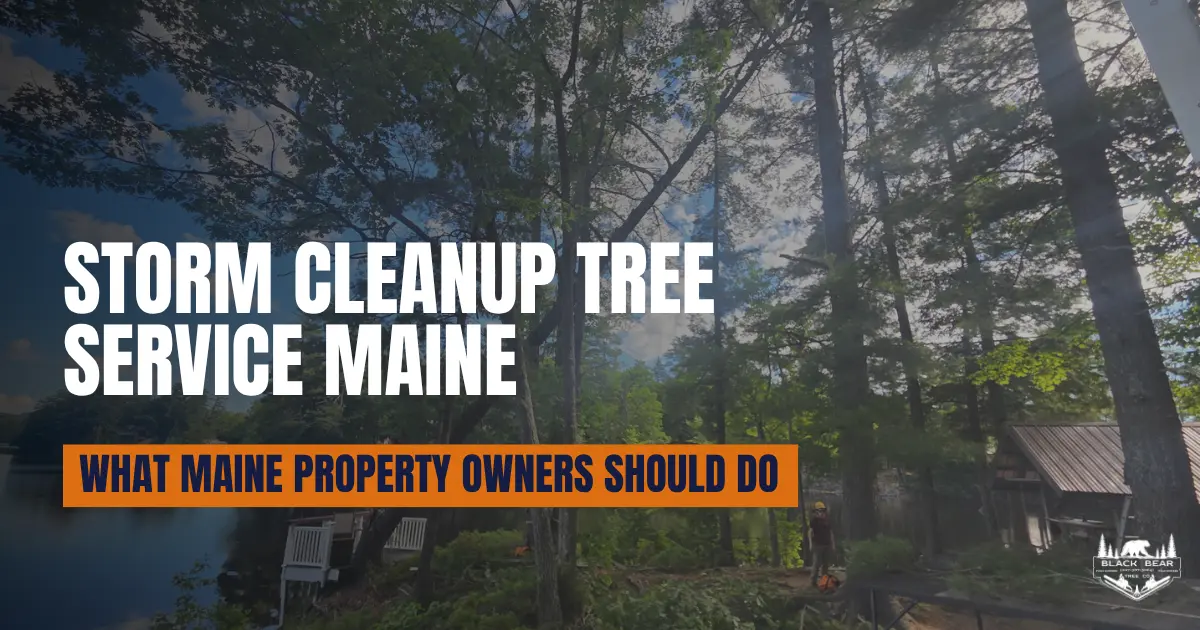
Storm Cleanup Tree Service Maine: What Maine Property Owners Should Do
High winds can leave Maine properties covered with broken branches, uprooted trees, hanging limbs, blocked driveways, damaged roofs, and hidden electrical hazards. Once the wind subsides, it can be tempting to begin cutting and moving debris immediately—but storm-damaged trees can remain unstable long after the weather passes.
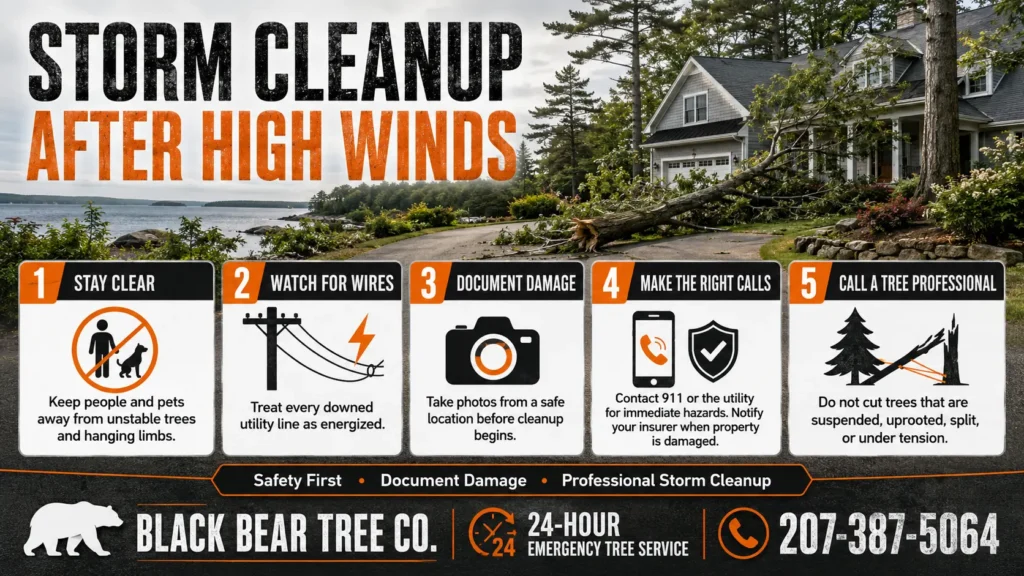
If a tree has fallen on a house, crossed a driveway, contacted utility lines, or appears likely to fall, keep people and pets away from the area. Contact the utility company or emergency services first when electrical lines or an immediate threat to life are involved.
Black Bear Tree Co. provides professional storm cleanup in Southern Maine, including hazardous-limb removal, fallen-tree removal, debris processing, and 24-hour emergency tree service.
For urgent assistance, call Black Bear Tree Co. at 207-387-5064. For non-emergency storm damage, request a free onsite estimate.
What Should You Do Immediately After a Windstorm?
Follow these steps in order:
- Make sure everyone is safe.
- Stay away from downed or sagging utility lines.
- Do not enter visibly damaged parts of a building.
- Keep people and pets away from unstable trees.
- Call 911 if someone is injured or the damage creates an immediate danger.
- Report downed power lines to the appropriate utility company.
- Photograph the damage from a safe location.
- Contact your insurance company when covered property may be involved.
- Call a professional tree service to evaluate hazardous trees.
- Wait for clearance before entering the work area or moving debris.
Do not climb a storm-damaged tree, work beneath a hanging branch, or operate a chainsaw near a fallen trunk under tension. A qualified Southern Maine tree service can identify hazards that may not be obvious from the ground.
Quick Storm-Damage Safety Checklist
Before approaching storm debris, ask:
- Are any electrical or communication lines down?
- Is a tree touching or leaning toward a utility line?
- Has a tree struck a house, garage, vehicle, or propane tank?
- Is anyone trapped or unable to leave the property?
- Is the driveway or road completely blocked?
- Are branches hanging overhead?
- Has the ground lifted around an uprooted tree?
- Is a split trunk still partially standing?
- Are bent branches or trunks under heavy tension?
- Does the tree move or make cracking sounds?
- Has the storm damaged the roof or structural framing?
- Is the area flooded or covered by unstable debris?
If the answer to any of these questions is yes, remain clear of the area and request professional assistance.
Stay Away From Downed Power Lines
Treat every downed wire as energized.
A tree or limb does not need to rest directly on a visible power line to become dangerous. Electricity can travel through wet wood, metal fencing, equipment, standing water, or nearby objects. Utility lines may also be concealed beneath branches and leaves.
Central Maine Power warns property owners not to remove tree debris around downed wires because energized lines may be tangled within it. Report hazardous lines to CMP at 800-696-1000 and review its official storm-safety guidance.
If wires are sparking, burning, blocking a public road, or creating an immediate danger, call 911.
Do not:
- Touch a fallen line
- Touch a tree contacting a line
- Drive over a downed wire
- Attempt to move a wire with wood or another object
- Use a chainsaw near utility lines
- Assume a line is safe because the power is out
- Allow children or pets into the area
The utility company must address the electrical hazard before a storm cleanup tree service in Maine can safely complete applicable tree work.
When Is Storm Damage a Tree Emergency?
Not every fallen branch requires emergency service. Emergency response is generally appropriate when a tree or limb:
- Has fallen on an occupied structure
- Is blocking the only driveway or access point
- Has trapped a person or vehicle
- Is resting on a roof
- Has damaged utility equipment
- Is leaning toward a house after partial uprooting
- Has a split trunk that could fail without warning
- Is suspended above a road, walkway, or entrance
- Prevents emergency vehicles from reaching the property
- Threatens neighboring property
- Has shifted and remains under extreme tension
- Is likely to cause additional damage before routine service is available
Black Bear Tree Co. provides emergency tree removal throughout Southern Maine for fallen trees, broken trunks, dangerous hanging limbs, blocked access, and storm-related hazards.
For urgent help, call 207-387-5064.
When Can Storm Cleanup Wait?
Routine scheduling may be appropriate when:
- Branches are already on the ground
- No structures or vehicles are threatened
- The driveway remains usable
- No utility lines are involved
- The remaining tree appears stable
- The debris is located away from occupied areas
- There are no hanging limbs above frequently used spaces
Even when the situation is not an emergency, avoid working beneath damaged trees until they have been inspected. A branch can break internally while remaining lodged in the canopy.
Submit photographs through Black Bear’s free estimate request to help the team understand the initial scope.
Do Not Rush to Cut a Fallen Tree
A fallen tree is not necessarily a stable tree.
Storm-damaged trunks and branches can contain stored mechanical energy. When one supporting section is cut, another section can roll, spring, split, drop, or shift unexpectedly. This is especially dangerous when a tree is:
- Partially uprooted
- Bent beneath another tree
- Suspended above the ground
- Resting against a structure
- Tangled with another canopy
- Split vertically through the trunk
- Loaded by heavy branches
- Positioned on a slope
- Covered by snow or other debris
- Under tension from a lifted root plate
Professional storm damage tree removal may require rigging, mechanical assistance, controlled dismantling, or crane-assisted tree removal.
A chainsaw alone does not make a storm-damaged tree safe to remove.
Look Up Before Walking Under Trees
Many post-storm injuries come from overhead hazards rather than debris already on the ground.
Examine trees from a safe distance and look for:
- Broken limbs lodged in the canopy
- Branches hanging by strips of bark
- Fresh splits where major limbs connect
- A newly leaning trunk
- Exposed or lifted roots
- Cracks extending down the trunk
- A top broken out of a tree
- Limbs resting on neighboring trees
- Broken branches above roofs or vehicles
- Movement during light wind
- Hanging vines supporting broken material
Do not stand underneath a suspected hazard to obtain a better photograph. Use a wide-angle view from an open, protected location.
A professional tree evaluation can determine whether damaged parts can be pruned or whether the entire tree requires removal.
Document the Damage Before Cleanup Begins
If a tree has damaged insured property, document the scene before moving material—provided you can do so safely.
Take photographs or video showing:
- The entire affected area
- Where the tree originated
- The tree’s position against the structure
- Roof, siding, window, fence, or vehicle damage
- Blocked entrances and driveways
- Uprooted soil and root damage
- Broken branches remaining overhead
- Utility lines or equipment involved
- Damage from several angles
- Nearby property and access conditions
- Visible pre-existing defects when relevant
- Debris before and after emergency stabilization
Also record:
- The date and approximate time of the storm
- When the damage was discovered
- Weather conditions
- Contractors contacted
- Conversations with the utility company
- Your insurance claim number
- Emergency expenses and invoices
Do not delay necessary emergency action solely to collect extensive photographs. Protecting people and preventing additional damage come first.
Contact Your Insurance Company
Homeowners insurance coverage depends on the policy, what caused the tree to fall, what the tree damaged, and the type of cleanup required.
Contact your insurer promptly when a tree damages:
- A house
- A garage
- A shed covered by the policy
- A fence
- A vehicle
- Utility equipment
- Another insured structure
Ask the insurer:
- Whether emergency tree removal is covered
- Whether approval is required before non-emergency work
- How to submit photographs
- Whether an adjuster must inspect the property
- Whether temporary protection is covered
- What documentation the tree company should provide
- Whether debris removal has a separate limit
- Whether your deductible applies
- Whether driveway access qualifies for limited coverage
The Maine Bureau of Insurance explains that coverage for a tree that did not strike a structure may be limited. Some policies provide removal coverage when a tree blocks a driveway or prevents a person with a disability from accessing the home. Review the state’s storm-related insurance claim FAQs and confirm the details with your own insurer.
Black Bear Tree Co. can provide an estimate or invoice describing the agreed tree-service work, but the insurance company determines coverage.
Can Emergency Work Begin Before the Adjuster Arrives?
Sometimes immediate work is necessary to:
- Rescue or protect occupants
- Open essential access
- Remove an immediate collapse hazard
- Allow utility crews to work
- Prevent a tree from causing additional structural damage
- Permit temporary roof protection
- Comply with instructions from emergency personnel
Call your insurer as soon as reasonably possible and document the conditions before work begins. If the property is safe enough to wait, ask the insurer whether an inspection or approval is required.
Emergency stabilization and complete restoration may happen in separate phases.
What Does a Storm Cleanup Tree Service in Maine Do?
The exact scope depends on the damage. Professional storm cleanup may include:
- Evaluating fallen and standing trees
- Establishing a safe work area
- Coordinating around utility restrictions
- Removing trees from roofs or structures
- Removing broken hanging limbs
- Dismantling split or partially uprooted trees
- Opening blocked driveways
- Cutting and processing fallen trunks
- Chipping branches
- Moving logs to an agreed location
- Hauling debris when included
- Grinding storm-created stumps when requested
- Inspecting nearby trees for visible damage
- Cleaning the agreed immediate work area
Black Bear Tree Co.’s storm cleanup service is customized to the property. Cleanup, hauling, logs, chips, and stump work should be defined in the approved estimate rather than assumed.
How Storm Damage Tree Removal Works
Every storm-damaged tree requires a different removal plan, but the process often includes:
1. Initial Hazard Assessment
The crew evaluates the tree, surrounding property, utilities, access, remaining structural support, and risk of movement.
2. Work-Zone Control
People, vehicles, and unnecessary equipment are kept outside the hazard area.
3. Stabilization
A damaged tree may require ropes, rigging, machinery, or a crane before cutting begins.
4. Controlled Removal
Branches and trunk sections are removed in an order designed to limit uncontrolled movement and additional property damage.
5. Material Processing
Branches may be chipped, logs cut, and debris consolidated or hauled according to the approved scope.
6. Remaining-Tree Inspection
Nearby trees may have broken limbs, root movement, new leans, or canopy damage caused by the same storm.
7. Optional Stump Work
If an uprooted or broken tree leaves an unwanted stump, professional stump grinding may be scheduled when conditions allow.
Learn more about the specialized removal process in our Storm Damage Tree Removal in Maine guide.
Can a Storm-Damaged Tree Be Saved?
Possibly. Storm damage does not automatically mean a tree must be removed.
A tree may be a candidate for corrective pruning when:
- The trunk remains structurally sound
- The root system has not shifted
- Damage is limited to smaller branches
- The primary trunk and major unions remain intact
- Enough healthy canopy remains
- The tree is not creating an unacceptable risk
- Corrective pruning can restore a reasonable structure
Removal may be recommended when:
- The tree has uprooted
- The trunk has split
- A major structural leader has failed
- Severe decay is exposed
- The remaining canopy is badly unbalanced
- Multiple large limbs have torn from the trunk
- The tree leans toward an occupied area
- Root damage has compromised stability
- Safe restoration is not practical
A licensed professional should evaluate borderline cases. Learn how the options differ in our Tree Trimming vs. Tree Removal in Sanford guide or explore tree trimming in Southern Maine.
Tree Removal After a Storm
Tree removal after a storm can be more difficult than scheduled removal because the tree may be:
- Resting on a structure
- Partially supported by broken framing
- Tangled with other trees
- Surrounded by debris
- Inaccessible to standard equipment
- Loaded unevenly
- Split or uprooted
- Near damaged utilities
- Blocking equipment access
- Unstable in changing wind
These conditions affect the time, equipment, crew size, and removal method required.
If the tree is stable and no longer threatens people or property, removal may be scheduled as routine tree removal in Southern Maine. If it remains dangerous, emergency tree removal may be necessary.
How Much Does Storm Cleanup Cost in Maine?
Storm-cleanup cost depends on:
- Tree size
- Number of trees
- Tree condition
- Where the tree landed
- Proximity to structures
- Utility involvement
- Equipment access
- Rigging requirements
- Crane requirements
- Time of response
- Debris volume
- Hauling requirements
- Stump work
- Weather and ground conditions
- Whether work must happen in phases
Black Bear’s current emergency removal pricing commonly falls around $650 to $2,700 or more, but complicated removals involving large trees, houses, cranes, limited access, or several hazards may exceed that range.
Review the complete Emergency Tree Removal Cost in Southern Maine guide for more detailed pricing information.
For project-specific pricing, request a free storm-cleanup estimate.
Does Storm Cleanup Include Debris Removal?
Debris handling depends on the approved estimate.
Possible arrangements include:
- Chipping branches
- Hauling chips away
- Leaving chips onsite
- Cutting logs into agreed lengths
- Leaving usable wood onsite
- Hauling logs away
- Consolidating debris in one area
- Removing damaged brush
- Grinding a remaining stump
- Leaving stump grindings onsite
- Removing grindings when specified
Ask how branches, logs, chips, leaves, and grindings will be handled. Avoid absolute assumptions that every piece of storm debris will automatically be removed.
What About a Tree That Fell From a Neighbor’s Property?
First, focus on immediate safety and property protection. Then:
- Document where the tree originated and where it landed.
- Photograph the property damage.
- Contact your insurance company.
- Notify the neighboring property owner.
- Avoid making accusations about liability.
- Obtain a professional removal estimate.
- Preserve relevant written communication.
Responsibility can depend on the circumstances, tree condition, prior notice, negligence, property ownership, and applicable law. A tree company can remove or evaluate the tree but cannot determine legal liability. Ask your insurer or a qualified Maine attorney about your specific situation.
What If the Tree Blocks the Driveway?
A blocked driveway becomes urgent when it:
- Prevents occupants from leaving
- Prevents emergency vehicle access
- Blocks access required by a person with a disability
- Traps vehicles needed for work or medical care
- Prevents utility or repair crews from entering
- Creates an unsafe public-road condition
Do not cut beneath a suspended trunk or attempt to pull the tree with a passenger vehicle. Call Black Bear’s emergency tree-service team for an evaluation.
Insurance coverage for driveway clearance varies, so document the obstruction and contact your carrier.
Should You Remove Every Damaged Tree?
No. Removing every tree affected by a storm may be unnecessary and can eliminate healthy shade, screening, habitat, and property value.
Prioritize:
- Immediate hazards
- Trees with root movement
- Split trunks
- Broken limbs above occupied spaces
- Trees leaning toward structures
- Severely damaged trees unlikely to recover
- Debris blocking essential access
Then evaluate less urgent damage individually. Professional arborist services in Southern Maine can help determine which trees may recover with appropriate care.
Inspect the Property Again After Cleanup
Once immediate hazards and debris have been addressed, walk the property from a safe distance and look for:
- Newly exposed trees
- Trees that lost protection from surrounding woods
- Cracked branch unions
- Hanging limbs
- Root plates lifted from the soil
- Fresh trunk cracks
- Trees leaning more than before
- Broken tops
- Bark torn from major limbs
- Damage above driveways and walkways
- Trees now exposed to prevailing winds
The loss of one tree can change how wind moves through the remaining stand. A neighboring tree that initially looks undamaged may now carry more wind exposure.
Preparing for the Next Windstorm
Storm damage cannot always be prevented, but preventive tree care can reduce avoidable risk.
Schedule Hazard-Tree Evaluations
Inspect large trees near:
- Houses
- Garages
- Driveways
- Roads
- Utility service lines
- Play areas
- Patios
- Parking areas
- Neighboring buildings
Remove Dead or Unstable Trees
A dead tree close to a frequently used area may be less expensive and less disruptive to remove before it falls. Request a routine tree-removal evaluation before the next major storm.
Prune Weak or Dead Branches
Professional tree trimming can remove certain dead, damaged, weak, or overextended limbs. Improper topping or aggressive pruning may create new problems and should be avoided.
Keep Access Clear
Make sure gates, driveways, and equipment routes are accessible. Inform the tree company about septic systems, wells, propane lines, soft ground, and private utilities.
Keep Insurance Information Available
Store policy numbers, claim contact information, utility numbers, and contractor contacts where they remain available during an outage.
Why Hire a Professional Storm Cleanup Tree Service?
Post-storm tree work can involve unstable wood, overhead hazards, structures, utility restrictions, tensioned branches, heavy logs, difficult footing, and rapidly changing conditions.
The Maine Forest Service recommends using qualified professionals for storm-damaged trees requiring climbing or chainsaw work and advises property owners to verify licensing, insurance, and references. Review the agency’s storm-cleanup safety reminders.
Before hiring a tree company, confirm:
- Appropriate insurance
- Relevant licensing or arborist credentials
- Experience with storm-damaged trees
- Suitable equipment
- The exact work included
- Debris-handling arrangements
- Stump-work arrangements
- The estimated price
- Payment terms
- Whether subcontractors will be involved
Black Bear Tree Co. is a local, fully insured tree-service company based in Limerick. Browse recent Southern Maine tree-service projects or learn more about Black Bear Tree Co..
Storm Cleanup Service Areas
Black Bear Tree Co. provides storm cleanup, fallen-tree removal, hazardous-limb removal, and emergency tree service throughout York and Cumberland counties.
Service areas include:
- Limerick
- Limington
- Cornish
- Newfield
- Waterboro
- Sanford
- Buxton
- Hollis
- Dayton
- Shapleigh
- Parsonsfield
- Alfred
- Standish
- Gorham
- Saco
- Biddeford
- Kennebunk
- Scarborough
- Windham
- Portland
For communities without a dedicated location page, visit Black Bear’s Southern Maine service-area page.
Emergency response depends on current storm conditions, road access, utility clearance, equipment availability, location, and the number of active calls.
Frequently Asked Questions
Who should I call when a tree falls during a storm?
Call 911 when someone is injured or the tree creates an immediate threat to life. Report downed utility lines to the appropriate utility company. Once electrical and emergency hazards are addressed, call a professional storm cleanup tree service in Maine to evaluate and remove the tree.
Does Black Bear Tree Co. provide 24-hour emergency tree removal?
Yes. Black Bear Tree Co. provides 24-hour emergency tree service for fallen trees, hazardous limbs, blocked access, and trees threatening structures. For urgent assistance, call 207-387-5064.
Can I cut up a fallen tree myself?
Small branches already on open ground may sometimes be manageable, but trees under tension, suspended trunks, hanging limbs, uprooted trees, structure damage, steep terrain, and utility involvement require professional evaluation. Never use a chainsaw near downed wires.
Will homeowners insurance pay for storm damage tree removal?
Coverage depends on the policy and circumstances. Removal may be covered when a tree damages an insured structure, while coverage may be limited when the tree only falls in the yard. Some policies provide limited coverage for blocked access. Contact your insurer for a policy-specific decision.
Should I call my insurance company or tree service first?
Address immediate safety first. Call emergency services or the utility company when required. If the situation is stable, contact your insurer and a qualified tree company promptly. Emergency action may be necessary before an adjuster arrives when continued delay could endanger people or cause additional damage.
What if a tree is resting on my roof?
Stay out of the affected part of the building and watch for utility, fire, gas, and structural hazards. Call emergency services when there is an immediate threat. Document the damage safely, contact your insurer, and request professional storm damage tree removal.
Can a tree be saved after losing a large branch?
Possibly. The decision depends on the tree’s species, condition, location, amount of canopy lost, wound size, remaining structure, root stability, and future risk. A professional tree evaluation is required.
Does storm cleanup include stump grinding?
Not automatically. Stump work should be specifically included in the estimate. Review the Stump Grinding Cost in Southern Maine guide for typical pricing factors.
How quickly can storm cleanup begin?
Response depends on the severity of the hazard, utility clearance, weather, road access, equipment needs, location, and current call volume. Fallen trees threatening occupied structures or blocking essential access are generally prioritized over routine debris cleanup.
Do you remove all branches and logs?
Material handling depends on the approved estimate. Branches may be chipped, logs cut or hauled, and chips may remain onsite or be removed. Confirm every part of the cleanup scope before work begins.
How much does emergency tree removal cost?
Black Bear’s general emergency tree-removal range is approximately $650 to $2,700 or more. Large trees on structures, complicated rigging, crane work, restricted access, and multiple damaged trees can increase the cost.
Can Black Bear remove a tree from a house?
Yes. Depending on the situation, removal may involve controlled rigging, specialized machinery, or crane tree removal. Utility and structural hazards must be addressed as part of the response plan.
Get Storm Cleanup Help in Southern Maine
High winds can transform healthy-looking trees into dangerous property hazards within minutes. The safest response is to remain clear of damaged trees, report utility hazards, document property damage, contact your insurer, and have unstable trees evaluated professionally.
Black Bear Tree Co. provides the storm cleanup tree service Maine property owners need for fallen trees, hanging branches, blocked driveways, storm debris, and dangerous trees threatening homes or other structures.
For urgent help, call 207-387-5064.
For non-emergency work, request a free storm-cleanup estimate.
Fully Insured • Licensed Maine Arborist • 24-Hour Emergency Tree Service • Serving York and Cumberland Counties