How Much Does Brush Clearing Cost in Southern Maine? 2026 Pricing Guide
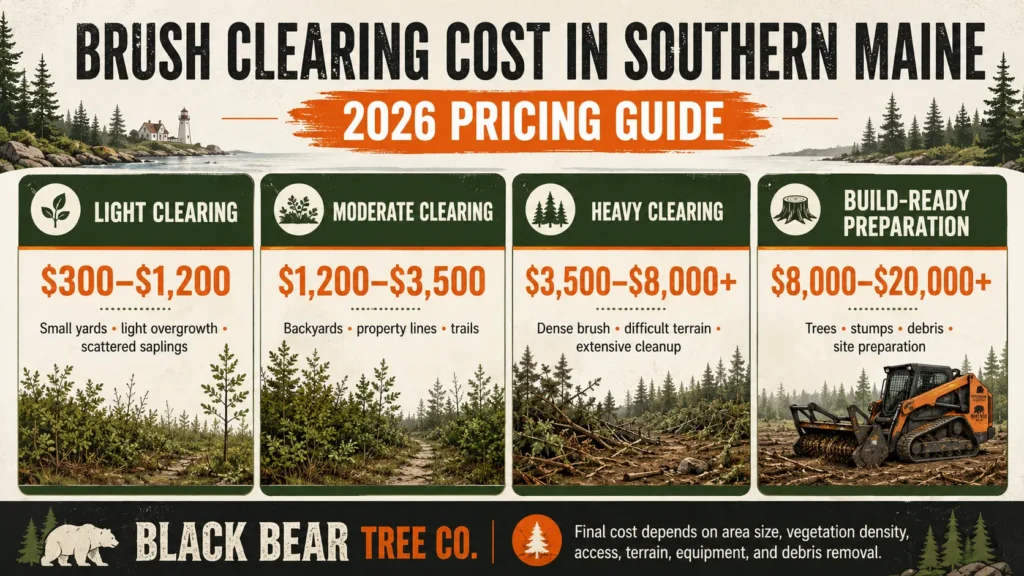
The brush clearing cost in Southern Maine typically ranges from $300 to $8,000 or more, based on current Black Bear Tree Co. pricing. Projects that also require stump grinding, grading, extensive tree removal, or build-ready site preparation may range from $8,000 to $20,000 or more.
Most projects fall into one of these categories:
| Brush-clearing project | Estimated cost |
|---|---|
| Light brush clearing | $300–$1,200 |
| Moderate brush clearing | $1,200–$3,500 |
| Heavy brush and overgrowth | $3,500–$8,000+ |
| Build-ready property preparation | $8,000–$20,000+ |
These are planning ranges rather than guaranteed quotes. The amount you pay depends on the size of the area, vegetation density, terrain, access, equipment requirements, debris disposal, and whether additional services are needed.
Black Bear Tree Co. provides professional brush clearing throughout Southern Maine for residential properties, commercial land, trails, property lines, yards, fields, and future project areas.
Request a free on-site estimate or call Black Bear Tree Co. at 207-387-5064 for accurate pricing.
Average Brush Clearing Cost in Southern Maine
The average brush clearing cost in Southern Maine cannot be determined by acreage alone. Two similarly sized areas may require very different amounts of time and equipment.
An open area containing tall grass, saplings, and light brush will generally cost less than an equally sized area containing:
- Dense woody vegetation
- Mature shrubs
- Small trees
- Vines and invasive growth
- Rocky or uneven terrain
- Hidden stumps
- Wet ground
- Old fencing or debris
- Limited equipment access
Black Bear Tree Co. evaluates the entire project before providing a quote. That allows the estimate to reflect the actual work instead of relying on a generic per-acre price that may not fit the property.
Light Brush Clearing: $300–$1,200
Light brush-clearing projects generally involve small, accessible areas with limited overgrowth and few obstacles.
Examples may include:
- Reopening the edge of a backyard
- Clearing around a shed or garage
- Removing light roadside overgrowth
- Cutting back an overgrown property line
- Opening a short walking path
- Removing scattered saplings
- Clearing vegetation around a fence
- Reclaiming a small section of lawn
Light projects may be completed using handheld equipment, chainsaws, chippers, or compact machinery.
If the project is located near Limerick, explore Black Bear’s dedicated brush clearing in Limerick, Maine.
Moderate Brush Clearing: $1,200–$3,500
Moderate projects typically include thicker vegetation, more woody growth, small trees, or a larger clearing area.
These projects may involve:
- Reclaiming an overgrown backyard
- Clearing a long property boundary
- Creating or widening trails
- Opening access to another part of the property
- Removing small trees mixed with brush
- Clearing around a camp or seasonal home
- Preparing an area for landscaping
- Restoring a neglected field edge
Professional equipment can make this work substantially faster and safer than attempting to clear the area manually.
Property owners near Sanford can review Black Bear’s Sanford brush-clearing services or complete tree service in Sanford, Maine.
Heavy Brush and Overgrowth: $3,500–$8,000+
Heavy brush clearing may involve dense vegetation, extensive acreage, difficult terrain, small trees, embedded debris, or areas that have been unmanaged for many years.
Examples include:
- Heavily overgrown lots
- Dense sapling growth
- Large areas of mature brush
- Steep or rocky terrain
- Restricted access
- Vegetation surrounding structures
- Multiple trails or long property lines
- Sites requiring extensive chipping or hauling
- Areas containing downed trees and old debris
Some heavy projects overlap with lot clearing in Southern Maine. If large trees, numerous stumps, or construction preparation are involved, the project may require more than brush clearing alone.
Build-Ready Preparation: $8,000–$20,000+
A build-ready project goes beyond cutting and removing vegetation. It may require:
- Brush removal
- Tree removal
- Stump grinding
- Debris hauling
- Grading
- Excavation
- Surface preparation
- Access-road or driveway clearing
- Extensive equipment work
If you are preparing land for construction, review Black Bear’s 2026 lot-clearing cost guide and lot-clearing services.
A contractor, excavator, builder, or engineer may also be required for portions of the project beyond Black Bear Tree Co.’s scope.
Brush Clearing Cost by Project Type
The purpose of the cleared area affects how much work must be completed.
| Project type | Common scope |
|---|---|
| Backyard reclamation | Brush, saplings, vines and debris |
| Property-line clearing | Narrow corridor through vegetation |
| Trail clearing | Defined path with overhead and side clearance |
| Field-edge clearing | Woody growth encroaching into open land |
| Structure clearance | Controlled removal around buildings |
| View improvement | Selective clearing rather than complete removal |
| Lot preparation | Brush, trees, stumps and debris |
| Build-ready preparation | Complete clearing plus additional site work |
A simple access trail generally requires less work than preparing the same area for a lawn, driveway, septic system, or structure.
What Affects Brush Clearing Cost?
Several factors determine the final estimate.
Size of the Clearing Area
A larger area usually requires more labor, fuel, equipment time, and debris processing. However, the price does not always increase evenly with acreage.
A large, open area with light vegetation may cost less than a much smaller section containing tangled woody brush, trees, rocks, and restricted access.
That is why Black Bear Tree Co. generally prices projects based on the entire scope rather than acreage alone.
Brush Density
Vegetation density is one of the biggest pricing factors.
Light weeds, grasses, and scattered saplings are relatively quick to clear. Intertwined shrubs, vines, mature brush, and dense small trees require more cutting, processing, and cleanup.
Properties that have been unmanaged for many years often contain several layers of vegetation that are difficult to identify until work begins.
Vegetation Type
Not all vegetation can be handled the same way. The project may contain:
- Tall grass
- Woody shrubs
- Thorny plants
- Vines
- Saplings
- Small trees
- Dead limbs
- Fallen trees
- Invasive plants
- Regrowth from old stumps
Some invasive plants can spread when cut or transported incorrectly. The federal National Invasive Species Information Center explains that invasive species are non-native organisms capable of causing environmental, economic, or health-related harm.
Identifying problematic vegetation before work begins can help determine the most appropriate removal and disposal method.
Tree and Sapling Size
Brush clearing frequently includes saplings and very small trees, but larger trees may require separate professional tree removal.
Tree size can affect:
- Cutting time
- Rigging requirements
- Equipment selection
- Chipping volume
- Wood handling
- Stump treatment
- Overall safety
If trees are close to a house, driveway, utility line, or other structure, the project may need a more controlled removal plan.
For large or difficult trees, Black Bear also provides crane tree removal throughout Southern Maine.
Terrain and Ground Conditions
Flat, firm and accessible ground is easier to work on than:
- Steep slopes
- Rocky ground
- Wet areas
- Soft soil
- Uneven terrain
- Drainage channels
- Areas containing ledge
- Sites with hidden holes or stumps
Wet ground may limit equipment access or require the project to be scheduled when conditions are firmer. Difficult terrain can also slow cutting, material handling, and cleanup.
Equipment Access
Professional equipment helps complete brush-clearing projects efficiently, but it must be able to reach the work area.
Cost can increase when access is limited by:
- Narrow gates
- Fences
- Septic systems
- Retaining walls
- Soft lawns
- Steep slopes
- Low branches
- Buildings
- Utility equipment
- Neighboring property
A site visit allows the crew to identify safe access routes and choose equipment that fits the property.
Debris Processing and Removal
The estimate may change depending on what you want done with the cleared material.
Common options include:
- Chipping material on site
- Hauling brush away
- Leaving wood for the property owner
- Creating an organized brush pile
- Cutting usable wood into manageable sections
- Spreading processed material in approved areas
Hauling debris away usually costs more than processing or leaving suitable material on the property because it requires additional labor, truck capacity, transportation, and disposal.
Stumps and Roots
Basic brush clearing does not necessarily remove every stump or root system.
Small vegetation may be cut close to ground level, but larger stumps can remain unless grinding or extraction is included in the estimate.
Black Bear Tree Co. provides stump grinding throughout Southern Maine. You can also review the 2026 stump-grinding cost guide and the differences between stump grinding and stump removal.
If you plan to mow, landscape, build, or drive over the cleared area, discuss stump treatment before accepting the estimate.
Nearby Structures and Utilities
Brush growing around a house, garage, shed, propane tank, fence, septic system, or utility equipment must be removed carefully.
Crews may need to work more slowly or use smaller equipment to protect surrounding property.
Before digging, stump extraction, or other ground disturbance occurs, underground utilities may also need to be identified.
Cleanup Expectations
“Cleared” can mean different things to different property owners.
One customer may only need vegetation cut so they can walk through the area. Another may expect the property to be clean, smooth, and ready for landscaping.
Before work begins, confirm whether the estimate includes:
- Cutting vegetation
- Removing saplings
- Chipping brush
- Hauling debris
- Removing fallen wood
- Grinding stumps
- Raking or final cleanup
- Grading or leveling
- Seeding or erosion control
A well-defined scope helps prevent surprises.
Is Brush Clearing Priced by the Hour, Day or Acre?
Brush clearing may be estimated by the project, equipment time, crew time, acreage, or a combination of these factors.
For most residential projects, a complete project estimate is usually more useful than a basic hourly rate because it considers:
- Mobilization
- Crew size
- Equipment
- Vegetation density
- Access
- Terrain
- Debris handling
- Expected completion time
Per-acre pricing can be misleading when it does not account for site conditions. An on-site inspection provides a more reliable brush clearing cost in Southern Maine.
Brush Clearing vs. Lot Clearing Cost
Brush clearing and lot clearing are related, but they are not always the same service.
Brush Clearing
Brush clearing generally focuses on:
- Shrubs
- Vines
- Tall vegetation
- Saplings
- Small trees
- Trail and boundary growth
- Light fallen debris
Lot Clearing
Lot clearing may include:
- Large trees
- Dense brush
- Stumps
- Extensive debris
- Construction access
- Grading coordination
- Full property preparation
Brush clearing is normally the more affordable option when the goal is simply to reclaim an overgrown area.
If the property must be prepared for a building, driveway, lawn, or major improvement, complete lot clearing may be more appropriate.
Brush Clearing vs. Forestry Mulching
Brush cutting, mechanical removal, chipping, and forestry mulching produce different results.
Forestry mulching uses specialized machinery to cut and process vegetation into material left on the ground. Traditional brush clearing may use a combination of cutting, chipping, hauling, and selective removal.
The best method depends on:
- Vegetation size
- Desired finish
- Ground conditions
- Property access
- Future use
- Environmental limitations
- Whether material can remain on site
Black Bear Tree Co. can evaluate the property and explain which clearing approach fits the project.
Does Brush Clearing Include Tree Removal?
Small saplings may be included, but larger tree removal can add to the project cost.
Trees become a separate consideration when they require:
- Directional felling
- Climbing
- Rigging
- Crane assistance
- Protection for nearby structures
- Large wood processing
- Separate stump grinding
For projects containing mature trees, review the tree-removal cost guide for Southern Maine.
If you are uncertain whether a tree should be trimmed or removed, a licensed arborist can evaluate its condition and location.
Can Brush Clearing Help Reduce Tick Habitat?
Clearing brush does not eliminate ticks, but it can make parts of a property less favorable to them.
The University of Maine Cooperative Extension Tick Lab recommends clearing leaf litter, tall grass, and brush from around homes, stone walls, woodpiles, and lawn edges as part of landscape management.
Other recommended steps include:
- Keeping lawns mowed
- Removing leaf litter
- Increasing sunlight in frequently used areas
- Moving woodpiles away from the home
- Creating separation between wooded and recreational areas
Brush clearing should be viewed as one part of an overall property-maintenance plan rather than a guarantee against ticks.
Do You Need Permission to Clear Brush in Maine?
Some routine brush clearing may not require a permit, but restrictions can apply depending on the property and project.
Before clearing, check for:
- Shoreland-zoning restrictions
- Wetlands
- Stream or drainage buffers
- Local ordinances
- Utility easements
- Property boundaries
- Homeowners-association requirements
- Protected natural resources
The Maine Department of Environmental Protection’s shoreland vegetation guidance explains that clearing near lakes, rivers, streams, coastal areas, and certain wetlands may be restricted.
Do not assume that all vegetation can be removed simply because it is on private property. Contact your municipal code-enforcement office when the project is close to water or involves substantial land disturbance.
Can Brush Clearing Cause Erosion?
Removing too much vegetation can expose soil to rainfall and runoff, particularly on slopes.
Roots, leaf litter, and ground cover help stabilize soil. If a project exposes bare ground, the next steps may include mulch, seeding, erosion-control materials, drainage improvements, or other stabilization measures.
This is especially important when clearing:
- Steep slopes
- Shorefront property
- Stream banks
- Drainage paths
- Areas with sandy soil
- Construction sites
- Large continuous sections of vegetation
Tell the estimator how you plan to use the land so the clearing approach supports the next phase of the project.
When Is the Best Time to Clear Brush in Southern Maine?
Brush clearing can be completed during much of the year, but the best timing depends on ground conditions and the project’s purpose.
Winter
Frozen ground may improve equipment access in some wet or soft areas. Leafless vegetation can also make the site easier to evaluate.
Snow depth, frozen debris, severe weather, and short daylight hours may create limitations.
Spring
Spring can reveal winter storm damage and new growth, but saturated ground may be too soft for heavy equipment.
Summer
Summer offers long working days and visible vegetation. Dense foliage can increase the amount of material that must be processed.
Fall
Fall can be a good time to reclaim property after the growing season or prepare access before winter. Scheduling may become busier as property owners complete seasonal projects.
The ideal time depends on soil conditions, access, vegetation, weather, and how soon you need the area available.
How to Reduce Brush Clearing Costs
You may be able to keep the project within budget by planning the scope carefully.
Mark the Exact Area
Identify the boundaries before the estimate. Clearly marked limits help the contractor understand exactly what should remain and what should be removed.
Decide How the Area Will Be Used
A basic walking trail does not require the same finish as a new lawn, driveway, building site, or equipment-access route.
Avoid paying for unnecessary finish work, but do not under-prepare an area that will need additional work later.
Identify Obstacles
Tell the estimator about:
- Wells
- Septic systems
- Underground utilities
- Fences
- Drainage pipes
- Old foundations
- Hidden debris
- Property pins
- Wet areas
- Sensitive landscaping
Knowing about obstacles beforehand can prevent delays and damage.
Bundle Related Work
If you also need tree removal, tree trimming, stump grinding, or lot clearing, completing related work during the same mobilization may be more efficient.
Be Flexible About Debris
If suitable material can remain on the property, you may reduce hauling and disposal costs. Confirm where and how it will be left before work starts.
Schedule Before the Property Becomes Impassable
Vegetation becomes more expensive to clear as it grows thicker, larger, and more tangled. Addressing overgrowth earlier can keep the project simpler.
Is DIY Brush Clearing Worth It?
Small areas of light vegetation may be manageable for a homeowner using basic hand tools.
Professional help is generally safer when the project includes:
- Chainsaw work
- Large saplings or trees
- Steep terrain
- Hidden debris
- Poisonous plants
- Nearby structures
- Utility lines
- Mechanical equipment
- Large amounts of material
- Extensive hauling
- Unstable or storm-damaged trees
Equipment rental, fuel, protective gear, disposal, transportation, and time can make a DIY project more expensive than expected.
Never attempt to cut vegetation or trees touching electrical lines. Contact the utility and keep people away from the area.
What Should a Brush-Clearing Estimate Include?
Before comparing quotes, confirm what each contractor has included.
A complete estimate should clarify:
- The exact clearing area
- Which vegetation will be removed
- Whether small trees are included
- Equipment being used
- Stump treatment
- Debris processing
- Hauling and disposal
- Protection for structures and landscaping
- Final cleanup
- Work not included
- Estimated scheduling
- Insurance coverage
- Total price or pricing method
The lowest quote is not necessarily the best value if it leaves brush piles, sharp stumps, damaged ground, or unfinished work.
Brush Clearing Services Across Southern Maine
Black Bear Tree Co. serves property owners throughout York and Cumberland counties.
Dedicated clearing and local service pages include:
- Brush clearing in Southern Maine
- Brush clearing in Limerick
- Brush clearing in Sanford
- Brush clearing in Gorham
- Brush clearing in Buxton
- Lot clearing in Sanford
- Land clearing in Limerick
Black Bear also provides complete tree services in:
- Alfred
- Biddeford
- Buxton
- Cornish
- Dayton
- Gorham
- Hollis
- Kennebunk
- Limerick
- Limington
- Newfield
- Parsonsfield
- Portland
- Saco
- Sanford
- Scarborough
- Shapleigh
- Standish
- Waterboro
- Windham
If your town does not have a dedicated location page, visit the complete Southern Maine tree-services hub to confirm availability.
Frequently Asked Questions
How much does brush clearing cost in Southern Maine?
The brush clearing cost in Southern Maine typically ranges from $300 to $8,000 or more. Light clearing generally costs $300–$1,200, moderate clearing costs $1,200–$3,500, and heavy brush clearing costs $3,500–$8,000 or more. Build-ready preparation may cost $8,000–$20,000 or more.
What is included in brush clearing?
Brush clearing may include cutting and removing shrubs, vines, tall vegetation, saplings, small trees, and light debris. The exact scope depends on the estimate. Stump grinding, large tree removal, grading, and extensive hauling may be priced separately.
How much does it cost to clear one acre of brush?
Per-acre costs vary substantially because vegetation density, tree size, terrain, access, debris handling, and the desired finish all affect the amount of work. An on-site estimate is more reliable than applying one generic acreage rate.
What is the difference between brush clearing and lot clearing?
Brush clearing focuses primarily on undergrowth, shrubs, vines, saplings, and smaller vegetation. Lot clearing may include large trees, stumps, extensive debris, grading coordination, and preparation for construction.
Review Black Bear’s lot-clearing cost guide if you need more extensive land preparation.
Does brush clearing include stump removal?
Not necessarily. Small growth may be cut at or near ground level, but stump grinding or extraction should be identified separately in the estimate.
Black Bear provides professional stump grinding when the remaining stumps need to be reduced below grade.
Can you clear brush around a house or garage?
Yes. Brush can be selectively removed around homes, garages, sheds, fences, driveways, and other structures. Access, utilities, landscaping, and the proximity of vegetation to the structure may affect the cost.
Can brush clearing help with ticks?
Removing brush, tall grass, and leaf litter can make frequently used portions of a property less favorable to ticks, but it cannot eliminate them. The University of Maine recommends vegetation management as one part of a broader tick-management strategy.
Do you remove the cleared debris?
Debris can generally be chipped, hauled away, processed, or left in an agreed-upon area. Confirm the selected option and its cost before work begins.
Can you clear a trail or property line?
Yes. Professional brush clearing can reopen trails, establish access, improve visibility, and define overgrown property boundaries.
Property lines should be confirmed before work begins. A contractor should not be expected to determine a disputed legal boundary.
How long does brush clearing take?
Small projects may be completed in several hours. Moderate projects may require a day or more, while extensive or difficult properties can take several days. Weather, ground conditions, vegetation density, access, and cleanup requirements affect the schedule.
Is brush clearing available for commercial properties?
Yes. Black Bear Tree Co. provides tree and clearing services throughout Southern Maine for residential, commercial, municipal, and multi-acre properties.
Is Black Bear Tree Co. licensed and insured?
Black Bear Tree Co. is fully insured and operated by a licensed Maine arborist. The company provides professional brush clearing, tree removal, trimming, stump grinding, storm cleanup, and property-clearing services.
Get an Accurate Brush Clearing Cost in Southern Maine
The cost to reclaim an overgrown property depends on much more than square footage. Vegetation density, terrain, trees, access, debris handling, equipment, and your plans for the finished area all influence the estimate.
Black Bear Tree Co. provides professional brush clearing in Southern Maine with clear recommendations, professional equipment, and free on-site estimates.
Whether you need to reclaim part of your yard, reopen a trail, clear a property line, remove heavy overgrowth, or prepare for a larger project, the crew can evaluate the property and develop the right plan.
Request your free estimate today or call Black Bear Tree Co. at 207-387-5064.