SEO Settings
Primary keyword: Lot Clearing Cost in Southern Maine
SEO title: Lot Clearing Cost in Southern Maine: 2026 Pricing Guide
URL: /lot-clearing-cost-southern-maine/
H1: Lot Clearing Cost in Southern Maine: 2026 Pricing Guide
Meta description: Learn the average lot clearing cost in Southern Maine for brush, trees, stumps and debris removal, plus the factors that affect your 2026 estimate.
Category: Tree Service Tips
Tags: lot clearing, land clearing, Lot Clearing Cost in Southern Maine, lot clearing prices, land clearing cost per acre, brush clearing, stump grinding, tree removal, Southern Maine tree service
Lot Clearing Cost in Southern Maine: 2026 Pricing Guide
If you are preparing land for a new home, driveway, addition, yard expansion, trail, or other property improvement, one of your first questions is probably: How much does lot clearing cost in Southern Maine?
Most lot-clearing projects fall between $500 and $10,000 or more, but that broad range only tells part of the story. A small area covered in brush is considerably different from a heavily wooded lot containing mature trees, large stumps, rocks, steep terrain, and limited equipment access.
The final price depends on:
- The amount of land being cleared
- Tree size and density
- Brush and sapling thickness
- Terrain and ground conditions
- Equipment access
- Stump requirements
- Debris handling
- Nearby structures and utilities
- The property’s intended use
Black Bear Tree Co. provides professional lot clearing throughout Southern Maine for residential and commercial properties.
To receive an accurate price for your property, request a free lot-clearing estimate or call Black Bear Tree Co. at 207-387-5064.
Average Lot Clearing Cost in Southern Maine
The following ranges can help you begin planning a budget:
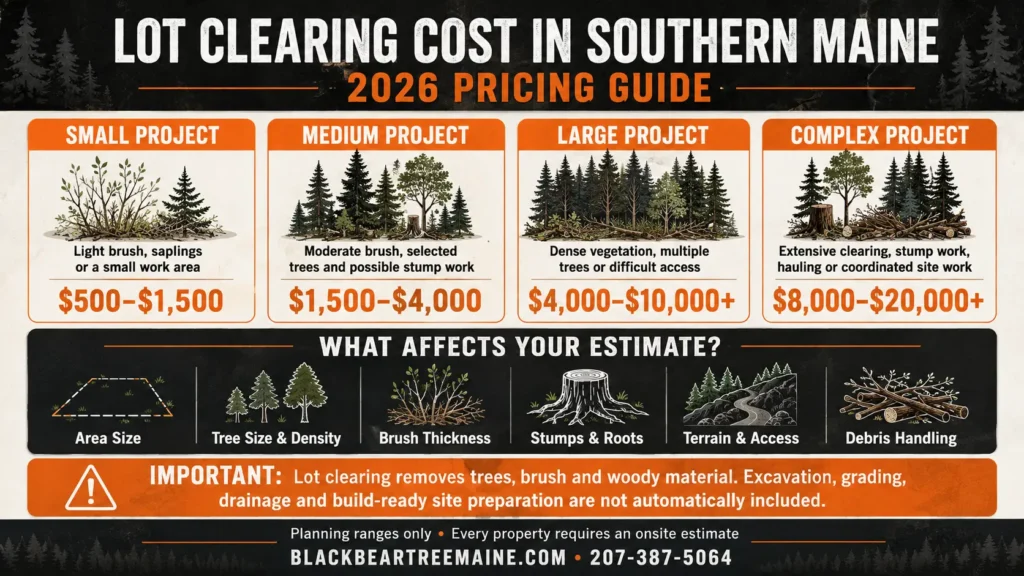
| Project type | Typical scope | Estimated cost |
|---|---|---|
| Small clearing project | Light brush, saplings, or a small work area | $500–$1,500 |
| Medium clearing project | Moderate brush, selected trees, and possible stump work | $1,500–$4,000 |
| Large clearing project | Dense vegetation, multiple trees, difficult access, or extensive cleanup | $4,000–$10,000+ |
| Complex property preparation | Extensive clearing combined with stump work, hauling, or coordinated site work | $8,000–$20,000+ |
These are general planning ranges—not guaranteed prices. Some projects may cost less, while heavily wooded, difficult, or unusually large properties can cost considerably more.
An estimate should identify exactly what is included. Tree and vegetation clearing should not automatically be interpreted as finished excavation, drainage work, grading, compaction, or completely build-ready site preparation.
Schedule a free onsite evaluation for project-specific pricing.
Quick Answer: How Much Does Lot Clearing Cost?
For many Southern Maine properties, the cost can be summarized this way:
- Light brush or a small backyard area: approximately $500–$1,500
- Mixed brush and small-tree clearing: approximately $1,500–$4,000
- Heavily wooded or larger projects: approximately $4,000–$10,000+
- Extensive, complicated projects: $10,000 or more
The amount of acreage alone does not determine the price. Clearing one dense acre containing mature hardwoods can cost substantially more than clearing several open acres containing light vegetation.
What Is Included in Lot Clearing?
Lot clearing can include several different services depending on the condition of the property and its intended use.
A Black Bear Tree Co. estimate may include:
- Removing selected trees
- Cutting small trees and saplings
- Clearing thick brush and overgrowth
- Processing fallen trees and woody debris
- Creating access into an overgrown area
- Removing vegetation around a proposed driveway or building area
- Grinding selected stumps
- Handling logs, brush, chips, and grindings
- Cleaning the agreed work area
Projects involving mostly vegetation and saplings may only require brush clearing in Southern Maine. Properties containing mature trees may require professional tree removal, while visible stumps may require stump grinding.
Your written estimate should clearly describe:
- The boundaries of the work area
- Which trees will be removed
- Whether stumps are included
- How debris will be handled
- Whether logs or firewood will remain
- Whether chips or grindings or grindings will be removed
- Any access or property-protection requirements
- Work that must be completed by another contractor
What Affects Lot Clearing Cost in Southern Maine?
No two Southern Maine lots are identical. The following factors have the greatest influence on the final price.
1. Size of the Clearing Area
A larger work area generally requires more equipment time, labor, fuel, and cleanup.
However, pricing does not always increase evenly by acreage. Mobilizing equipment creates a base project cost, so a one-acre job is not necessarily twice the price of a half-acre job.
Mark the exact area you want cleared before requesting an estimate. This prevents the contractor from pricing more—or less—land than you actually want addressed.
2. Tree Density
The number and spacing of trees can matter more than the total acreage.
An open lot containing scattered trees may be relatively straightforward. A dense stand containing closely spaced hardwoods, dead trees, tangled crowns, and limited working room requires considerably more planning.
If your lot contains only a few unwanted trees rather than a larger clearing area, a standard Southern Maine tree-removal estimate may be more appropriate.
3. Tree Size and Species
Large trees generally require more time and specialized equipment than brush or saplings.
Tree species also affect:
- Wood weight
- Trunk diameter
- Branch structure
- Cutting time
- Processing requirements
- Stump size
- Debris volume
Large Maine hardwoods can create substantial amounts of wood and brush even when only a few trees are removed.
For more information about individual tree prices, read our Tree Removal Cost in Southern Maine guide.
4. Brush and Vegetation Thickness
Dense brush can conceal:
- Rocks
- Old fencing
- Concrete
- Scrap metal
- Fallen trees
- Wells
- Drainage features
- Uneven ground
- Abandoned materials
- Stumps from previous cutting
These hidden obstacles can slow the work and affect which equipment can safely enter the area.
When mature-tree removal is not necessary, professional brush clearing may provide a less extensive and more affordable solution.
5. Stumps and Surface Roots
Tree removal does not automatically include stump grinding or full root-ball excavation.
Stump work can significantly affect the total lot-clearing cost when a property contains:
- Numerous stumps
- Large root flares
- Dense hardwood stumps
- Exposed surface roots
- Rocks surrounding the roots
- Stumps beside foundations or pavement
- Limited grinder access
Black Bear Tree Co.’s current general grinding ranges are:
| Stump diameter | Typical grinding cost |
|---|---|
| Under 12 inches | $100–$200 |
| 12–24 inches | $200–$400 |
| 24–36 inches | $400–$700 |
| Over 36 inches | $700+ |
Multiple stumps completed during one mobilization may be more cost-effective than scheduling each separately.
Read our complete Stump Grinding Cost in Southern Maine guide and Stump Grinding vs. Stump Removal comparison before choosing a method.
6. Equipment Access
Good access can reduce labor and machine time. Difficult access can increase both.
The estimate should consider:
- Driveway width
- Gate openings
- Overhead wires
- Low branches
- Septic systems
- Soft lawns
- Retaining walls
- Narrow passages
- Steep slopes
- Wet areas
- Weight-restricted surfaces
- Distance from the road or staging area
Sending wide-angle photographs with your quote request can help identify potential access limitations before the onsite visit.
7. Terrain and Ground Conditions
Southern Maine properties can contain steep slopes, ledge, boulders, wet ground, shallow soil, and uneven terrain.
These conditions may:
- Limit equipment movement
- Slow production
- Require a different machine
- Increase property-protection measures
- Restrict work during mud season
- Make hauling material more difficult
Frozen ground can sometimes improve access, but snow, ice, short daylight hours, and buried obstacles can create other complications.
8. Proximity to Houses and Other Structures
Clearing trees from an open area is generally less complicated than working beside:
- Houses
- Garages
- Sheds
- Driveways
- Roads
- Utility lines
- Septic systems
- Wells
- Fences
- Neighboring properties
Trees near structures may need to be dismantled in sections rather than felled into an open area. Certain large or high-risk trees may also require crane-assisted tree removal.
9. Debris Handling
Trees and brush do not disappear after they are cut. The amount of material produced—and what happens to it—can substantially affect the price.
Possible arrangements include:
- Leaving usable logs onsite
- Cutting logs to agreed lengths
- Chipping brush
- Consolidating material into a designated area
- Leaving chips onsite
- Hauling logs, brush, or chips away
- Removing stump grindings
- Coordinating material handling with another contractor
Ask whether hauling is included instead of assuming all material will be removed.
10. The Final Use of the Property
The desired result affects how much work is necessary.
Clearing an area for a trail or additional sunlight may require less work than preparing space for:
- A house
- A driveway
- A garage
- A septic system
- Utility installation
- A parking area
- A permanent shed
- A patio or other hardscape
Tell Black Bear Tree Co. what will happen after clearing. A stump that can remain beneath a natural walking trail may need a different solution if a foundation or driveway will occupy the same location.
Lot Clearing Cost Per Acre
Property owners frequently search for a single land-clearing price per acre, but acreage-based pricing can be misleading.
Published national estimates vary widely because “one acre” could mean:
- Open ground with weeds
- Thick brush and saplings
- Scattered mature trees
- Dense hardwood forest
- Wet or rocky terrain
- A steep hillside
- An accessible roadside lot
- A remote area without machine access
National 2026 estimates commonly place basic land clearing anywhere from approximately $1,200 to $8,000 per acre, with difficult and heavily wooded sites extending higher. These figures should only be used for preliminary budgeting.
Southern Maine pricing must account for the property’s actual vegetation, terrain, access, cleanup requirements, and intended use. An onsite estimate is considerably more reliable than multiplying acreage by a national average.
Brush Clearing vs. Lot Clearing Cost
Brush clearing generally costs less than full lot clearing because it focuses on:
- Overgrown vegetation
- Vines
- Small saplings
- Trail growth
- Fence lines
- Roadside growth
- Light woody material
Lot clearing may also require:
- Mature-tree removal
- Large equipment
- Technical rigging
- Stump work
- Extensive debris processing
- Multiple days of work
If you want to reclaim an overgrown backyard without removing mature trees, brush clearing may be the most practical scope.
If trees, stumps, and heavier woody material must be removed for a larger property project, lot clearing is likely more appropriate.
Does Lot Clearing Include Grading?
Not automatically.
Lot clearing primarily removes trees, brush, and woody material. Grading reshapes the soil to establish elevation, slope, drainage, or a construction surface.
Depending on your project, you may also need an excavation or site-work contractor for:
- Removing root balls
- Moving soil
- Installing drainage
- Supplying fill
- Compacting soil
- Rough grading
- Finish grading
- Excavating foundations
- Building driveways
- Installing septic systems
Do not assume that cleared land is automatically build-ready. Your builder, engineer, excavation contractor, or code-enforcement office may have specific site requirements.
Black Bear Tree Co. can coordinate the tree-clearing portion around the larger project plan.
Does Lot Clearing Include Stump Removal?
Stumps are only included when specifically listed in the estimate.
The right method depends on what will happen afterward:
- Lawn or landscaping: Stump grinding is often sufficient.
- Trail or natural area: Some low stumps may be left when appropriate.
- Foundation or permanent construction: Root-ball excavation may be necessary.
- Driveway or parking area: The site contractor may require stump and root removal.
- Utility trench: Roots within the excavation path may need to be addressed.
Standard stump grinding removes the visible stump and immediate root flare below grade but leaves most roots underground.
Can Valuable Timber Reduce the Cost?
Sometimes—but property owners should not assume that standing trees will pay for the clearing project.
The value of wood depends on:
- Species
- Trunk quality
- Diameter
- Volume
- Accessibility
- Current markets
- Distance to a mill
- Logging and trucking costs
- Whether enough merchantable timber exists
Residential trees often contain limbs, bends, metal, decay, or access complications that reduce their commercial value. A small wooded house lot is different from a managed timber harvest.
Any potential value should be evaluated separately rather than deducted from the budget before the site is inspected.
When Is the Best Time to Clear a Lot in Maine?
Lot clearing can be completed during different seasons, but conditions affect access and scheduling.
Winter
Frozen ground may help equipment cross soft areas with less disturbance. Snow depth, ice, buried obstacles, and shorter daylight can complicate the work.
Spring
Wet soil and mud can limit heavy-equipment access. Some properties may need to dry before clearing can begin safely.
Summer
Longer days and firmer ground often provide good working conditions, although dense foliage can make boundaries and hazards harder to see.
Fall
Cooler weather and reduced foliage can improve visibility, but scheduling may become busy before winter.
The best timing depends on the property, weather, access, permits, and the schedule of any builder or excavation contractor involved.
Do You Need a Permit to Clear Land in Maine?
Permit requirements depend on the municipality, location, size of the project, and proximity to protected resources.
Before clearing, contact your town’s code-enforcement office if the property involves:
- Shoreland zoning
- Lakes, ponds, rivers, or streams
- Freshwater or coastal wetlands
- Significant wildlife habitat
- Road entrances
- Subdivision restrictions
- Erosion-control requirements
- A planned building project
Maine’s shoreland rules can restrict vegetation clearing near water and wetlands. Review the Maine DEP guidance for clearing vegetation in the shoreland zone and confirm the rules applying to your specific property before work begins.
Wetland impacts may also require state, local, or federal review. The Maine DEP wetlands-protection overview explains the coordinated permitting process.
Black Bear Tree Co. provides tree and vegetation services but does not determine your property’s legal boundaries or replace advice from the applicable permitting authority.
Underground Utilities and Private Lines
Utilities must be considered whenever equipment will penetrate the ground.
The Maine Public Utilities Commission’s Dig Safe guidance requires the proposed excavation area to be pre-marked and 811 contacted at least three business days before applicable digging.
Dig Safe member utilities may not identify privately owned systems. Tell the estimator about:
- Septic tanks and leach fields
- Well lines
- Propane lines
- Private electrical service
- Invisible dog fences
- Irrigation
- Landscape lighting
- Drainage pipes
- Internet or communication lines
Never assume an underground installation is outside the work area or deep enough to avoid contact.
How to Reduce Your Lot-Clearing Cost
You may be able to control the project cost with careful planning.
Define the Exact Area
Avoid clearing more land than the project requires. Use stakes, flags, or paint to make the boundaries easy to understand.
Identify Trees That Can Stay
Preserving healthy trees can reduce removal, stump, cleanup, and restoration costs while maintaining privacy and shade.
If you are uncertain which trees should remain, request a professional tree evaluation.
Combine Related Work
Removing several trees or grinding multiple stumps during one mobilization may be more efficient than scheduling separate visits.
Decide What Material Can Remain
Keeping usable logs or chips onsite may reduce hauling, but only if you genuinely have an appropriate use and location for the material.
Provide Good Project Information
Include:
- The property address
- Approximate clearing dimensions
- Wide photographs
- Close photographs of large trees
- Access measurements
- Your project timeline
- The planned use of the area
- Known utilities and septic components
- Your preference for logs and debris
Coordinate Contractors Early
If a builder or excavator will complete the next phase, determine their stump, root, access, and grading requirements before tree work begins.
Why the Cheapest Lot-Clearing Quote May Cost More Later
A low estimate is not a good value if it leaves important work undefined.
Before choosing a contractor, confirm:
- Insurance coverage
- Exact clearing boundaries
- Trees included
- Stump scope
- Surface-root scope
- Debris handling
- Property-protection measures
- Cleanup expectations
- Payment terms
- Work excluded from the quote
An unclear estimate can lead to unexpected charges, unfinished cleanup, unwanted tree removal, or duplicated work by the next contractor.
Black Bear Tree Co. provides free estimates based on the actual property and agreed scope—not a generic price calculated from acreage alone.
How to Prepare for a Lot-Clearing Estimate
Before the site visit:
- Mark the proposed work area.
- Identify trees that must remain.
- Explain the intended use of the land.
- Locate surveys or boundary information.
- Identify septic and private utility locations.
- Measure gates and narrow access points.
- Decide whether you want logs or chips left onsite.
- Mention planned construction.
- Ask your builder whether stumps must be excavated.
- Confirm potential permit requirements with your municipality.
- Take photographs of the property and access route.
- Establish your ideal project schedule.
Black Bear Tree Co. can then evaluate the trees, brush, stumps, access, debris, and equipment requirements.
Why Choose Black Bear Tree Co.?
Black Bear Tree Co. is a locally owned and fully insured tree-service company based in Limerick, Maine.
Property owners choose Black Bear for:
- Free onsite estimates
- Clear project scopes
- Professional equipment
- Residential and commercial service
- Tree, brush, and stump coordination
- Careful work near homes and improvements
- Local knowledge of Southern Maine properties
- Straightforward communication
- Flexible debris-handling options
- Service throughout York and Cumberland counties
Learn more about Black Bear Tree Co., browse our recent tree-service projects, or explore more Southern Maine tree-service guides.
Lot Clearing Service Areas
Black Bear Tree Co. provides lot clearing, brush clearing, tree removal, and stump grinding throughout Southern Maine, including:
- Limerick
- Limington
- Cornish
- Newfield
- Waterboro
- Buxton
- Hollis
- Dayton
- Shapleigh
- Parsonsfield
- Sanford
- Alfred
- Standish
- Gorham
- Saco
- Biddeford
- Kennebunk
- Scarborough
- Windham
- Portland
Service availability depends on the location, project size, equipment access, and current schedule. If your town is not listed, contact Black Bear Tree Co. to ask about availability.
Frequently Asked Questions
How much does lot clearing cost in Southern Maine?
Lot clearing in Southern Maine may cost approximately $500 for a small, lightly overgrown area or exceed $10,000 for a large, heavily wooded, or complicated property. Tree density, stump work, access, debris handling, terrain, and the intended use of the land all affect the final price.
How much does it cost to clear one acre in Maine?
There is no reliable flat price for one acre because vegetation and site conditions vary enormously. National estimates often range from approximately $1,200 to $8,000 per acre, but heavily wooded or difficult properties may cost more. An onsite estimate is the best way to determine the actual cost.
Is brush clearing cheaper than lot clearing?
Usually. Brush clearing primarily addresses overgrowth, vegetation, and saplings. Lot clearing may involve mature trees, stumps, heavy equipment, and considerably more debris.
Does lot clearing include tree removal?
It can. Every tree to be removed should be identified in the written estimate. The price depends on tree size, condition, location, access, and proximity to structures.
Does lot clearing include stump grinding?
Not automatically. Stump grinding should be listed separately or specifically included in the approved project scope.
Does clearing include removing all the roots?
No. Standard stump grinding leaves most of the underground root system in place. Projects involving foundations, driveways, or excavation may require more extensive root-ball removal by an appropriate site contractor.
Does lot clearing include grading?
Not unless grading is specifically included. Tree and brush clearing is different from excavation, soil compaction, drainage work, and finished grading.
Can Black Bear Tree Co. clear land for new construction?
Black Bear Tree Co. can clear trees, brush, and woody material for planned homes, driveways, additions, and other improvements. The clearing work should be coordinated with the builder or excavation contractor responsible for subsequent site preparation.
How long does lot clearing take?
A small and accessible project may be completed within a day. Heavily wooded properties can require several days or multiple phases. Weather, terrain, equipment access, stumps, and cleanup affect the schedule.
Can I leave logs or wood chips onsite to save money?
Often, yes. Keeping suitable material onsite may reduce handling or hauling costs, depending on the project. Agree on the location and condition of the material before work begins.
Can lot clearing be completed during winter?
Yes, when property access and weather allow. Frozen ground can benefit some sites, although snow, ice, buried obstacles, and severe weather may affect production.
Do I need a permit to clear my property?
Possibly. Requirements depend on the municipality, shoreland zoning, wetlands, road access, acreage, soil disturbance, and intended land use. Contact your town’s code-enforcement office before work begins.
Will Dig Safe mark my septic system and private lines?
Not necessarily. Dig Safe coordinates participating utility mark-outs, but privately owned systems may require separate identification. Tell the contractor about septic components, well lines, propane, private power, irrigation, drainage, and invisible fences.
Can I clear only part of my property?
Yes. Selective clearing can create a building area, yard expansion, trail, view, driveway corridor, or improved access while preserving trees elsewhere.
Do you provide free lot-clearing estimates?
Yes. Black Bear Tree Co. provides free, no-obligation estimates based on the property, desired scope, equipment access, cleanup requirements, and intended use.
Get an Accurate Lot Clearing Estimate
The lot clearing cost in Southern Maine depends on much more than acreage. Tree size, vegetation density, terrain, access, stumps, debris, utilities, and the final use of the property all influence the scope.
Black Bear Tree Co. can inspect your property, discuss your plans, identify the services required, and provide a clear estimate for the tree, brush, stump, and woody-debris work.
Request your free lot-clearing estimate or call 207-387-5064.
Fully Insured • Local Maine Company • Residential and Commercial Service