How Much Does Land Clearing Cost in Maine? 2026 Pricing Guide
If you’re looking at an overgrown or wooded property and wondering how much land clearing costs in Maine, the answer depends heavily on what is actually on the property.
Clearing a lightly overgrown residential lot is very different from clearing an acre filled with mature trees, large stumps, rocks, steep terrain, and limited equipment access.
In Maine, those differences matter.
Our wooded properties, rocky ground, wetlands, changing terrain, and mature tree growth can make land clearing more complicated than simply pushing vegetation out of the way.
For homeowners and property owners in Southern Maine, the best way to estimate the cost is to understand what needs to be removed, how difficult it is to remove, and what you want the property to look like when the work is finished.
In this 2026 guide, we’ll break down the major factors affecting land clearing cost in Maine, including acreage, tree density, brush, stumps, equipment access, terrain, debris disposal, and site conditions.
Black Bear Tree Co. provides lot clearing throughout Southern Maine along with tree removal, brush clearing, stump grinding, and specialized tree work to help homeowners reclaim and prepare their properties.
What Does Land Clearing Cost in Maine?
There isn’t one reliable flat rate for land clearing because two properties of the same size can require dramatically different amounts of work.
Black Bear’s existing Southern Maine pricing provides a useful starting point. Current lot-clearing estimates range from roughly $500–$1,500 for small, lightly overgrown projects, $1,500–$4,000 for medium projects, and $4,000–$10,000+ for larger, heavily wooded projects. More extensive build-ready preparation involving clearing, stump work, grading, and cleanup can reach $8,000–$20,000+. These are planning ranges, not guaranteed quotes.
A relatively open residential lot containing saplings, brush, and a few small trees may require significantly less equipment and labor than a heavily wooded lot containing mature hardwoods, large pines, difficult terrain, and dozens of stumps.
For that reason, land-clearing estimates are usually based on:
- Total area being cleared
- Number and size of trees
- Tree species and condition
- Brush and undergrowth density
- Number and size of stumps
- Property access
- Terrain and slope
- Rocks and ledge
- Proximity to structures
- Debris-removal requirements
- Equipment required
- Desired finished condition
If most of the property is overgrowth rather than mature trees, compare those numbers with Black Bear’s 2026 brush clearing cost guide.
How Much Does Land Clearing Cost Per Acre in Maine?
One of the most common questions homeowners ask is:
How much does it cost to clear an acre of land in Maine?
Cost-per-acre figures can be useful for rough planning, but they can also be misleading.
Imagine two one-acre properties.
The first has mostly grass, brush, saplings, and a handful of medium-sized trees.
The second contains mature pines and hardwoods, dense undergrowth, large stumps, boulders, uneven terrain, and only one narrow access point.
They’re both one acre.
They are not remotely the same land-clearing job.
This is especially important in Southern Maine, where wooded residential properties can vary considerably even within the same town.
Instead of focusing exclusively on acreage, homeowners should consider the density and difficulty of everything being removed.
For projects where the primary goal is preparing a residential lot, see Black Bear’s complete lot clearing services in Southern Maine.
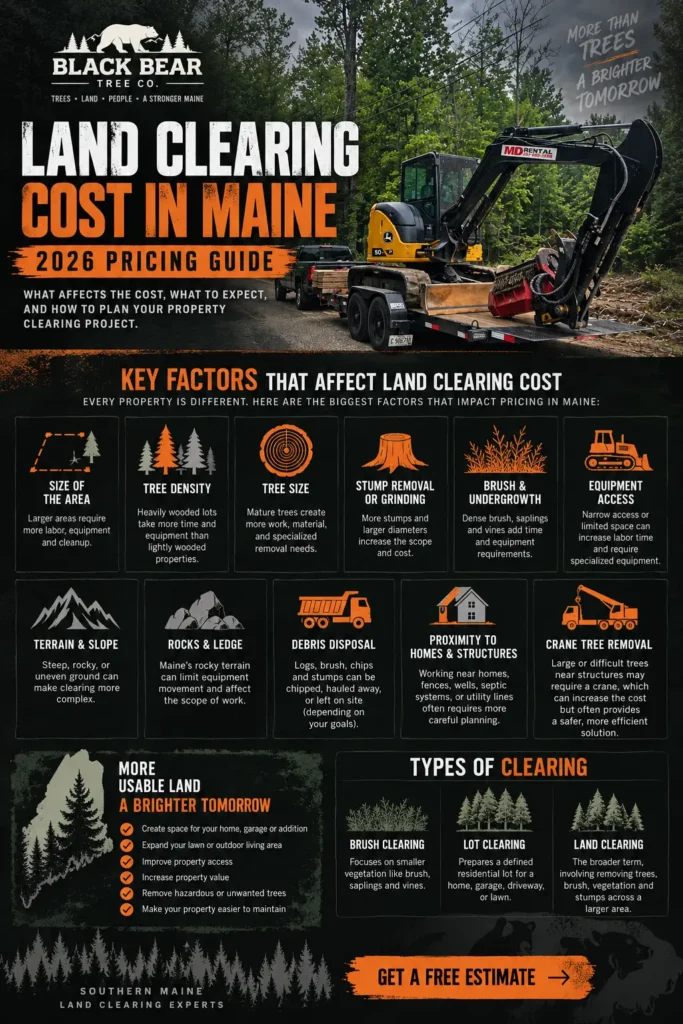
The 10 Biggest Factors Affecting Land Clearing Cost in Maine
1. Size of the Area Being Cleared
The total square footage or acreage is the obvious starting point.
Larger areas generally require more labor, equipment time, cutting, processing, and cleanup.
But size alone doesn’t determine price.
Clearing a quarter-acre packed with mature trees can potentially require more intensive tree work than clearing a much larger area dominated by brush and small growth.
That’s why an accurate estimate should evaluate the actual conditions of the property rather than applying one generic price per acre.
2. Tree Density
Tree density can dramatically change the scope of a land-clearing project.
A lightly wooded lot may contain enough space to maneuver equipment easily and process individual trees efficiently.
A heavily wooded lot can require considerably more cutting, rigging, processing, and material handling.
Dense growth can also limit where trees can safely fall.
If surrounding homes, garages, fences, utility lines, septic systems, or trees you want to preserve are nearby, individual trees may need to be handled much more carefully.
For properties with substantial mature tree growth, compare your clearing project with Black Bear’s 2026 tree removal cost guide.
3. Tree Size
Ten small trees and ten mature trees are completely different jobs.
Large trees produce more:
- Logs
- Limbs
- Brush
- Wood volume
- Stump material
They may also require more powerful equipment and more controlled removal techniques.
Large trees close to homes or other obstacles can sometimes require specialized removal rather than conventional felling.
That doesn’t necessarily mean specialized equipment always increases the total price. Black Bear notes that equipment such as cranes can sometimes make difficult tree removal safer and more efficient.
4. Stump Removal and Stump Grinding
Cutting down the tree doesn’t automatically make the land usable.
The stump remains.
If you’re clearing land for lawn expansion, landscaping, construction access, or another future use, you’ll need to decide what happens to those stumps.
Professional stump grinding in Southern Maine typically reduces the stump below the surrounding surface so the area can be reclaimed.
More extensive stump and root removal may be required for certain construction projects.
The number, diameter, location, tree species, root flare, rocks, and required grinding depth can all affect cost. Black Bear’s current residential stump-grinding guide places many individual stumps between approximately $100 and $700, with unusually large or complicated stumps potentially costing more.
For more detailed pricing, see the 2026 stump grinding cost guide.
5. Brush and Undergrowth
Not every land-clearing project involves large trees.
Sometimes the real problem is years of accumulated:
- Saplings
- Vines
- Shrubs
- Small trees
- Briars
- Dense undergrowth
- Storm debris
- Volunteer growth
If the mature trees can stay, targeted brush clearing may be significantly less involved than complete land clearing.
Black Bear’s current pricing guide estimates approximately $300–$1,200 for light brush clearing, $1,200–$3,500 for moderate clearing, and $3,500–$8,000+ for heavy brush and overgrowth.
See the complete brush clearing cost in Southern Maine guide if this better describes your property.
6. Equipment Access
Access is one of the most overlooked factors affecting land clearing cost in Maine.
Heavy equipment needs enough room to reach the work area safely.
A wide, open property with direct access from a driveway or road is typically easier to work on than a backyard accessible only through a narrow opening between a house and fence.
Poor access can affect:
- Equipment selection
- Material removal
- Labor requirements
- Tree-removal methods
- Project duration
When requesting an estimate, mention gates, narrow driveways, retaining walls, steep grades, soft ground, septic systems, and other potential obstacles.
7. Terrain and Slope
Maine isn’t exactly famous for perfectly flat, rock-free ground.
Steep slopes, uneven terrain, exposed ledge, boulders, wet areas, and soft ground can all affect the equipment that can safely operate on a property.
Terrain becomes particularly important when removing large trees.
A tree that could be removed relatively easily on open, level ground may require a completely different approach on a steep or constrained site.
8. Rocks and Ledge
Anyone who has dug into enough Maine properties knows rocks can quickly become part of the project.
Surface boulders and exposed ledge can restrict equipment movement and affect how an area can ultimately be graded or developed.
Tree and clearing crews can address vegetation, trees, and stumps within their scope, but major excavation, blasting, or extensive earthwork may require another contractor.
Identifying those limitations before work begins helps prevent surprises later.
9. Debris Disposal
Clearing land creates a lot of material.
Depending on the project, that can include:
- Logs
- Limbs
- Brush
- Chips
- Stumps
- Small vegetation
- Deadwood
What happens to that material affects the project scope.
Some homeowners may want usable logs left on site. Others want the area cleaned up as completely as practical.
Wood may be chipped, processed, hauled away, or handled differently depending on the size of the project and the homeowner’s plans.
When requesting an estimate, explain what you want the property to look like when the job is complete.
10. Proximity to Homes and Other Structures
Removing trees from an undeveloped open lot is generally different from clearing trees around an existing home.
Residential clearing can involve working near:
- Houses
- Garages
- Sheds
- Fences
- Wells
- Septic systems
- Driveways
- Utility lines
- Neighboring properties
Those obstacles can change how trees are removed and how equipment moves through the site.
This is one reason professional tree removal matters during residential land-clearing projects.
When Does Crane Tree Removal Affect Land Clearing Cost?
Most land-clearing jobs don’t automatically require a crane.
But certain large or difficult trees may benefit from crane tree removal in Southern Maine, especially when conventional removal would create unnecessary risk or property disturbance.
A crane may be appropriate when a tree is:
- Very large
- Close to a home
- Structurally compromised
- Difficult to access
- Surrounded by obstacles
- Unsafe to fell conventionally
Instead of dropping the entire tree, sections can be removed in a more controlled manner.
Black Bear uses crane-assisted removal for complex jobs involving large, hazardous, or hard-to-access trees near homes and other structures.
Crane work can add specialized equipment costs, but the important question isn’t simply whether a crane costs more—it’s which removal method can complete the work safely and efficiently.
Brush Clearing vs. Lot Clearing vs. Land Clearing
These terms are often used interchangeably, but they can describe different scopes of work.
Brush Clearing
Brush clearing focuses primarily on unwanted vegetation such as saplings, bushes, vines, and undergrowth.
It’s often appropriate when homeowners want to reclaim an overgrown portion of an otherwise established property.
If that’s your project, start with Black Bear’s brush clearing cost guide.
Lot Clearing
Lot clearing in Southern Maine generally involves preparing a defined residential lot or portion of a property for a specific use.
That might mean opening space for:
- A new home
- Garage
- Addition
- Driveway
- Lawn
- Shed
- Septic work
- Landscaping
Lot clearing can involve brush removal, tree removal, stump work, and debris removal.
Land Clearing
Land clearing is the broader term and can encompass removing substantial vegetation, trees, brush, and stumps from a larger area.
For many Southern Maine residential projects, the practical distinction matters less than identifying exactly what needs to be removed and what condition the property needs to be in afterward.
Does Clearing Heavily Wooded Land Cost More?
Usually, yes.
Heavily wooded properties typically involve more cutting, more material, more stumps, and more equipment time.
But tree density isn’t the only issue.
The size and location of those trees can be even more important.
Twenty mature trees surrounding a house may require substantially more controlled work than a larger number of smaller trees on an open lot.
That’s why Black Bear evaluates terrain, vegetation, access, and intended use when determining the appropriate combination of tree removal, brush clearing, stump grinding, and debris handling.
Can You Reduce the Cost of Land Clearing?
Sometimes—and the best way isn’t necessarily doing dangerous tree work yourself.
Start by defining what actually needs to be cleared.
You may not need every tree removed.
Keeping healthy, well-positioned trees can preserve:
- Privacy
- Shade
- Property character
- Natural screening
- Wildlife habitat
while reducing unnecessary removal work.
You may also be able to divide a large project into phases:
- Remove hazardous or unwanted trees.
- Clear brush and smaller vegetation.
- Grind necessary stumps.
- Complete excavation, grading, or landscaping separately.
A targeted approach can often make more sense than automatically clearing everything.
Do You Need a Permit to Clear Land in Maine?
Possibly.
Requirements depend on where the property is located, what is being done, whether timber is being harvested, whether the harvested wood is being sold, and whether state or municipal land-use rules apply.
The Maine Forest Service’s Forest Operations Notification guidance says a Forest Operations Notification (FON) is required in most cases when timber is harvested and the wood will be delivered to a mill or offered for sale. However, the state lists exemptions for certain residential and small-scale activities.
Importantly, an exemption from the FON requirement does not necessarily mean no permit is required. The Maine Forest Service specifically advises property owners to check with the applicable municipality or Land Use Planning Commission before cutting.
You can also review the Maine Forest Service rules and regulations before planning a substantial clearing project.
For residential projects, checking with your town’s Code Enforcement Officer or planning department before major clearing is a smart first step.
Clearing Land Near Lakes, Rivers and Wetlands in Maine
This deserves special attention.
Maine’s Mandatory Shoreland Zoning Act generally covers land within 250 feet of great ponds, rivers, coastal wetlands and defined freshwater wetlands, and within 75 feet of certain streams. Municipalities administer and enforce shoreland-zoning ordinances.
If your clearing project is close to water, review the official Maine DEP Shoreland Zoning information before removing vegetation.
Maine also has statewide standards for timber harvesting in shoreland areas that may apply depending on the location and activity.
Don’t assume the same clearing practices allowed elsewhere on your property are automatically allowed near:
- Lakes
- Rivers
- Streams
- Coastal wetlands
- Freshwater wetlands
Local ordinances may also differ, so confirm the requirements before work begins.
Call 811 Before Ground-Disturbing Work
Stump extraction, excavation, grading, and other clearing work can disturb soil.
Before digging, underground utilities need to be considered.
Dig Safe serves Maine and allows property owners and contractors to submit a utility notification by calling 811 or using its ticket system. Dig Safe then notifies participating utilities so their underground facilities can be marked.
Dig Safe emphasizes that property owners and professional contractors should notify the service before disturbing the earth, even on private property.
Is Land Clearing Worth It?
For the right property, it can be.
Clearing an unusable or overgrown section of land can create space for:
- A larger lawn
- New driveway
- Garage
- Home addition
- Outdoor living area
- Garden
- Shed
- Better property access
- Improved views
- Future residential construction
Selective clearing can also make wooded property easier to maintain without removing every tree.
The key is planning the project around what you actually want to accomplish.
If your goal is simply reclaiming an overgrown backyard, you may primarily need brush clearing.
If you’re creating usable space around a home, lot clearing may be the better fit.
If mature trees are the primary obstacle, tree removal and stump grinding may accomplish the goal without clearing the entire property.
What Should Be Included in a Land Clearing Estimate?
A good estimate should clearly establish the scope of work.
Before accepting a quote, make sure you understand:
- Which trees are being removed
- Whether brush clearing is included
- Whether stump grinding is included
- What happens to logs
- What happens to wood chips
- Whether debris is hauled away
- Whether cleanup is included
- What areas equipment needs to access
- Whether additional services will be required afterward
The cheapest initial number isn’t necessarily the least expensive project if important parts of the job weren’t included.
This is also why comparing a land-clearing estimate against the tree removal cost guide, stump grinding cost guide, and brush clearing cost guide can help you understand where the work is coming from.
Land Clearing in Southern Maine
Black Bear Tree Co. provides residential clearing and tree services throughout Southern Maine.
Depending on the property, your project may involve lot clearing, brush removal, stump grinding, conventional tree removal, or crane-assisted tree removal.
Black Bear serves communities throughout York and Cumberland counties, including:
Portland • Scarborough • Kennebunk • Biddeford • Saco • Gorham • Windham • Sanford • Standish • Buxton • Waterboro • Limerick • Hollis • Limington • Dayton • Alfred • Shapleigh • Newfield • Cornish • Parsonsfield
For example, homeowners can find dedicated Black Bear services for tree service in Biddeford, Maine and lot clearing in Buxton, Maine.
Get a Land Clearing Estimate in Southern Maine
The most accurate way to determine land clearing cost in Maine is to have someone look at the actual property.
Photos and acreage can provide useful context, but they don’t always reveal slope, access limitations, tree size, stump conditions, nearby structures, rocks, or how dense the vegetation really is.
Black Bear Tree Co. can evaluate the site, discuss what you’re trying to accomplish, and determine the appropriate combination of lot clearing services, tree removal, brush clearing, and stump grinding.
Whether you’re reclaiming part of an overgrown backyard or preparing a wooded residential lot for its next use, the goal is to clear what actually needs to be cleared rather than applying a one-size-fits-all approach.
Request a free estimate from Black Bear Tree Co.
Frequently Asked Questions About Land Clearing Cost in Maine
How much does it cost to clear an acre of land in Maine?
There isn’t a dependable one-price-fits-all cost per acre. Tree density, tree size, brush, stumps, rocks, terrain, access, debris handling, and the desired finished condition can dramatically change the price. Black Bear’s existing Southern Maine lot-clearing page provides planning ranges from roughly $500 for small projects to $10,000+ for heavy clearing, with more extensive site preparation potentially exceeding those ranges.
What is the biggest factor affecting land clearing cost?
Tree size and density are often major factors, but access, terrain, stump work, debris handling, and proximity to structures can be just as important. A smaller complicated site can sometimes require more work than a larger open property.
Is brush clearing cheaper than full land clearing?
Generally, yes. Brush clearing usually has a smaller scope because mature trees can remain. Black Bear’s brush clearing cost guide provides pricing examples for light, moderate, and heavy overgrowth.
Does land clearing include stump removal?
Not automatically. The scope varies by project. Ask whether stump grinding or full stump/root removal is included. If you’re preparing the property for construction, explain its intended future use before work begins.
Is tree removal included in land clearing?
It can be, but the amount of tree work varies considerably. Properties containing mature, hazardous, or difficult trees may require specialized removal. See Black Bear’s tree removal cost in Southern Maine guide for factors that affect individual tree-removal pricing.
Do I need to remove every stump after clearing land?
No. It depends on how you intend to use the property. Stumps in areas being converted to lawn, landscaping, access, or construction may need to be addressed, while stumps in unused wooded portions of the property may be able to remain.
Read stump grinding vs. stump removal to understand the differences.
Do I need a permit to clear trees on my Maine property?
Possibly. Maine has state and local requirements that depend on the type and location of the work. The Maine Forest Service FON guidance lists notification requirements and exemptions but specifically warns that tree cutting may still require approval from a municipality or the LUPC even when a Forest Operations Notification isn’t required.
Can I clear trees near a lake in Maine?
Tree and vegetation clearing near water may be subject to Maine’s shoreland rules and municipal ordinances. Maine DEP says the shoreland zone generally extends 250 feet from great ponds, rivers and specified wetlands and 75 feet from certain streams. Check the official Maine DEP Shoreland Zoning guidance and your municipality before clearing.
Can Black Bear clear an overgrown backyard?
Yes. Depending on the property, brush clearing, selective tree removal, and stump grinding can reclaim overgrown portions of a residential property without necessarily clearing the entire area.
What’s the difference between lot clearing and land clearing?
Lot clearing usually refers to clearing a defined residential lot or portion of a property for a particular use. Land clearing is a broader term that can include removing trees, brush, vegetation, and stumps across a larger area. Learn more about lot clearing in Southern Maine.
How long does land clearing take?
It depends on the acreage, tree density, terrain, equipment access, stump work, and cleanup requirements. A small residential clearing project can be very different from clearing a heavily wooded property. An on-site evaluation is the best way to estimate the project’s scope.
Can land clearing include tree trimming instead of removing every tree?
Yes. Selective clearing can preserve desirable trees while creating more light, clearance, access, or usable space. Complete clearing isn’t always necessary.
Can you remove hazardous trees while clearing a property?
Yes. Large or difficult trees near homes and structures may require crane tree removal in Southern Maine when a conventional removal isn’t appropriate.
What happens to all the wood after land clearing?
That depends on the project’s scope and your preferences. Logs, brush, chips, and other material may be processed, hauled away, or left in an agreed-upon form. Discuss debris handling before work begins so it’s clear what the finished property will look like.
How do I get an accurate land clearing estimate?
Schedule an on-site evaluation. The contractor can assess acreage, vegetation, tree size, stumps, terrain, equipment access, surrounding structures, and your plans for the property.
Get a free land clearing estimate from Black Bear Tree Co.
How much does stump grinding cost in Maine?
Black Bear’s current Southern Maine guide estimates many residential stumps at approximately $100–$700 each, with larger or more complicated stumps potentially costing more. Diameter, species, roots, access, rocks, grinding depth, cleanup, and the number of stumps all affect pricing. See the complete stump grinding cost guide.
Should I call 811 before land clearing?
If the work will disturb the ground, underground utilities need to be addressed. Dig Safe instructs property owners and contractors to submit a notification before digging so participating utilities can mark their facilities.